Publications & Preprints

QDL Physics Institute – Core Program Papers

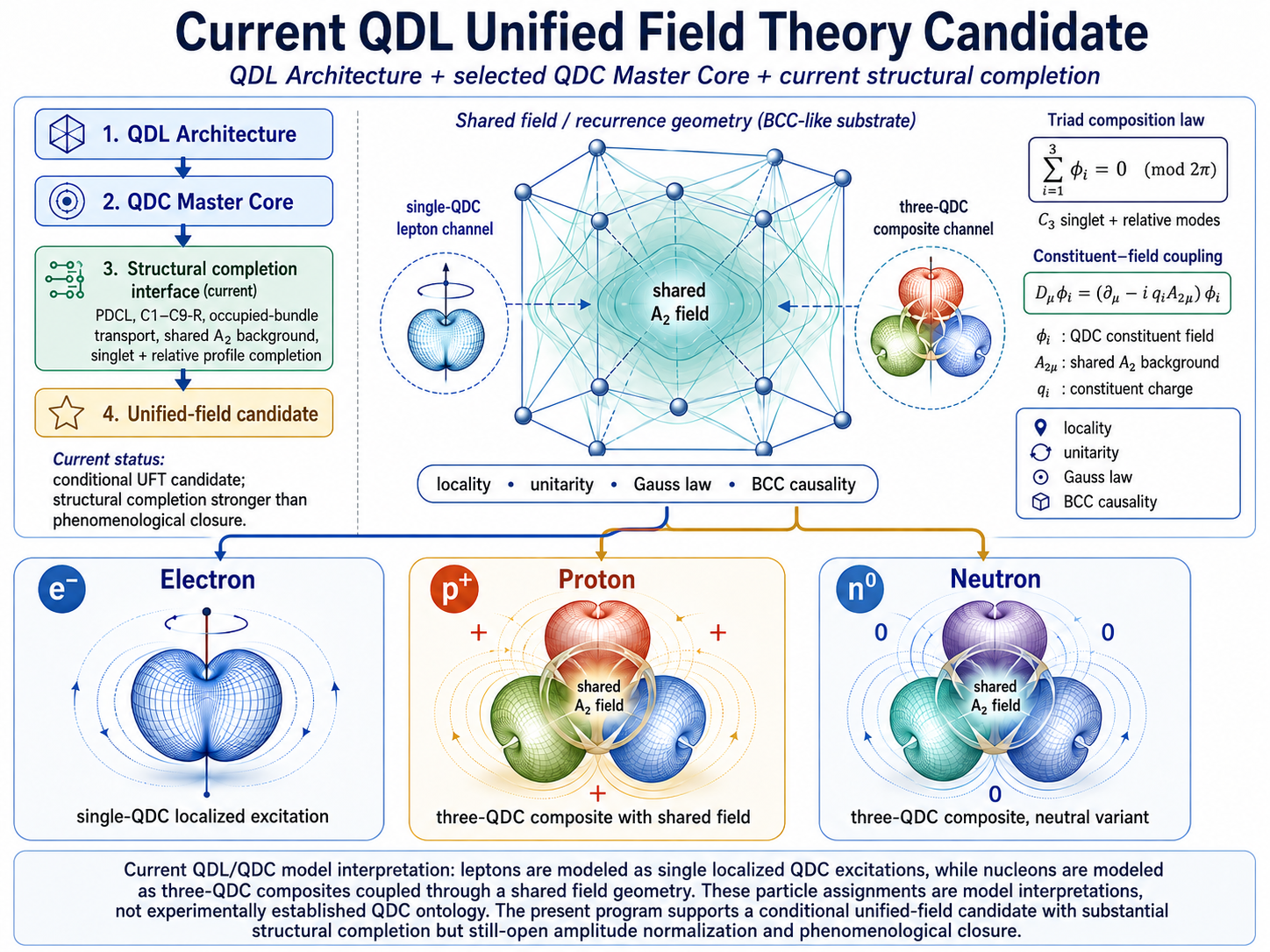
The QDL Physics Institute maintains an open set of preprints and submitted manuscripts describing the Quantized Dimensional Ledger (QDL) prediction filter, the 3L + 2F ledger and Quantized Dimensional Cell (QDC), unified treatments of the Standard Model and gravity, scalar–tensor–electromagnetic phenomenology, effective field theory and SMEFT structure, metrological ledgers for physical constants, and experimental validation protocols.

3L + 2F prediction filter
Quantum gravity from dimensional coherence
EFT & SMEFT structure
Metrology & constants
Experimental roadmap

Core Framework & Geometry

Papers that define the QDL prediction filter, the 3L + 2F ledger and Quantized Dimensional Cell, and the unified field-theoretic and geometric structure.

The Quantized Dimensional Ledger as a Prediction Filter for Field Content, EFT Structure, Constants, Gravity, and Precision Measurement

Bourassa, J. D. (2025). Zenodo. DOI: 10.5281/zenodo.17848782

Capstone paper formulating QDL as a structural prediction filter for admissible field content, EFT operators, and combinations of physical constants. A conserved 3L + 2F cell defines the ledger, and closure rules then link EFT structure, gravitational sectors, and precision metrology into a single dimensional framework.

Quantum Gravity from Dimensional Coherence: Minimum-Length Geometry from the Quantized Dimensional Ledger

Bourassa, J. D. (2025). Zenodo. DOI: 10.5281/zenodo.17848573

Develops a gravitational sector in which dimensional coherence under the QDL ledger yields a minimum-length geometry and coherence conditions for scalar–tensor structure, tying quantum gravity back to the same QDC that governs EFT and constants.

Quantized Dimensional Ledger as a Unified Dimensional Closure Framework for the Standard Model and Gravity

Bourassa, J. D. (2025). Zenodo. DOI: 10.5281/zenodo.17742903

Unified treatment of Standard Model fields and a scalar–tensor gravity sector under a common 3L + 2F closure rule, embedding fields, couplings, and constants into a shared ledger that closes onto a Quantized Dimensional Cell.

A Unified Ledger-Based Framework for Physical Theories: From Dimensional Cells to Scalar–Tensor Field Structure

Bourassa, J. (2025). Zenodo. DOI: 10.5281/zenodo.17704896

Earlier scalar–tensor field-theory development from QDC and ledger closure, establishing a route from dimensional cells to covariant actions and metrological interpretation. Superseded in scope by the prediction-filter and quantum-gravity papers but still useful for detailed scalar–tensor derivations.

The Quantized Dimensional Cell as an SO(3,2) Space–Time Structure

Bourassa, J. D. (2025). Zenodo. DOI: 10.5281/zenodo.17683786

Identifies the QDC as a 3L + 2F geometric object embedded in an SO(3,2)-like structure, linking ledger exponents to a higher-dimensional space–time–frequency geometry and supporting the minimum-length and coherent-ledger-field constructions.

EFT, SMEFT & Magnetic-Moment Structure

Papers applying QDL ledger closure to effective field theory operator lattices, SMEFT operator sets, and magnetic-moment (g–2) structure.

Dimensional Closure and Ledger Lattices in Effective Field Theories

Bourassa, J. D. (2025). Zenodo. DOI: 10.5281/zenodo.17773324

Develops the EFT operator space as a ledger lattice constrained by QDL closure. Shows how the integer-exponent ledger structure organizes admissible operators, exclusions, and dimensional relations among couplings and constants.

Ledger-Closure Constraints on the SMEFT: A Lattice-Theoretic Derivation of Operator Exclusions and Wilson-Coefficient Relations

Bourassa, J. D. (2025). Zenodo. DOI: 10.5281/zenodo.17780443

Applies QDL ledger-closure rules to the Standard Model Effective Field Theory, deriving structured exclusions of SMEFT operators and dimensional relations among Wilson coefficients, with the EFT lattice paper and prediction-filter framework as the underlying structure.

The Ledger Geometry of Magnetic Moments: A Quantized Dimensional Ledger Derivation of the Electron and Muon g–2 Factors

Bourassa, J. (2025). Zenodo. DOI: 10.5281/zenodo.17693061

Reinterprets electron and muon anomalous magnetic moments in terms of ledger geometry and dimensional flow, connecting loop corrections and g–2 factors to the QDL framework and coherent-ledger-field structure.

Metrology, Constants & Program Synthesis

Papers that organize physical constants and metrological chains in the QDL ledger, and synthesize the broader “Twenty Grand Challenges” program.

QDL: Twenty Grand Challenges, One Ledger – A Unified Dimensional-Closure Architecture for Spacetime, Fields, Constants, Cosmology, Nuclear Structure, Precision Physics, and Measurement

Bourassa, J. D. (2025). Zenodo. DOI: 10.5281/zenodo.17805400

Programmatic overview mapping QDL’s dimensional-closure architecture onto a set of twenty grand-challenge domains, from spacetime and cosmology to nuclear structure, SMEFT, precision physics, and metrology.

The Quantized Dimensional Ledger for Metrology: Dimensional Closure, QMU Ledgers, and the Ontology of Physical Constants

Bourassa, J. D. (2025). Zenodo. DOI: 10.5281/zenodo.17619526

Introduces the Quantized Measurement Unit (QMU) ledger as a dimensional audit tool, classifying physical constants and tying metrology practice directly to the QDL closure principle and the conserved QDC.

A Dimensional Closure Framework for the Ontology of Physical Constants

Bourassa, J. D. (2025). Zenodo. DOI: 10.5281/zenodo.17663436

Examines the ontology of physical constants under QDL: which constants reflect structural geometry versus unit choices, and how QDC closure organizes constant combinations into quantized dimensional classes.

Structural Constraints on Fundamental Constants from a Five-Dimensional Ledger Basis

Bourassa, J. D. (2025). Zenodo. DOI: 10.5281/zenodo.17663501

Derives constraints on fundamental constants using a five-dimensional ledger basis, providing a more technical complement to the metrology and ontology-of-constants papers.

Teaching, Phenomenology & Experiments

Papers that connect QDL to teaching, coherent ledger fields, and an explicit experimental roadmap across torsion, NV centers, cavity scaling, and metamaterials.

Coherent Ledger Fields: From SO(3,2) Dimensional Cells to a Unified Scalar–Tensor–Electromagnetic Phenomenology

Bourassa, J. D. (2025). Zenodo. DOI: 10.5281/zenodo.17803804

Connects the QDC and ledger geometry to scalar–tensor–EM phenomenology, with proposed signals in torsion-balance experiments, NV-center frequency shifts, cavity-mode scaling, metamaterials, and magnetic-moment structure.

Teaching Dimensional Analysis with a Length–Frequency Basis: An Inverse-Length Cavity Scaling Lab

Bourassa, J. D. (2025). Zenodo. DOI: 10.5281/zenodo.17663340

Undergraduate-level laboratory framework that demonstrates an L–F dimensional basis and cavity-mode scaling, serving as a pedagogical introduction to QDL-style dimensional analysis and resonance structures.

QDL Experimental Validation Protocol: A Unified Roadmap for Torsion, NV-Center, Cavity, and Metamaterial Tests

Bourassa, J. (2025). Zenodo. DOI: 10.5281/zenodo.17654442

Outlines a falsifiable experimental program across four independent platforms, designed to probe whether physical scaling follows a QDL-governed 3L + 2F ledger rather than conventional dimensional expectations alone.

Toroidal Coordinate Representation of the Schrödinger Equation with Cross-Domain Structural Applications

Bourassa, J. D. (2025). Zenodo. DOI: 10.5281/zenodo.17663608

Presents a toroidal-coordinate formulation of the Schrödinger equation with structural links to QDL geometry, offering cross-domain tools for analyzing resonant and geometric features relevant to ledger-based field structures.

Earlier QDL manuscripts, including initial gravitation–electromagnetism–metrology frameworks, remain available in the Zenodo community for historical completeness but are superseded in scope by the prediction-filter, quantum-gravity, and unified SM + gravity papers as primary references.

A complete, up-to-date list of QDL-related manuscripts and datasets is maintained via the Zenodo community:
https://zenodo.org/communities/qdl-physics-institute/ .