
Quantized Dimensional Ledger: Structural Admissibility Under Closure
QDL treats dimensional analysis as a structural admissibility layer: not only “units consistent,” but “structurally allowed.” Physical quantities are represented as integer ledger vectors in a 3L + 2F length-frequency basis, and admissible constructions are tested for closure relative to a distinguished Quantized Dimensional Cell.
This page states the minimal framework: definitions, assumptions, declared transforms, claim-status boundaries, and framework-level falsification conditions. Applications to metrology, EFT/SMEFT, QDC geometry, gravity, experiments, and validation infrastructure should be read as downstream uses of this admissibility layer.
Visual Orientation: Structural Admissibility
Use the entry animation first to see the formal workflow below in motion.
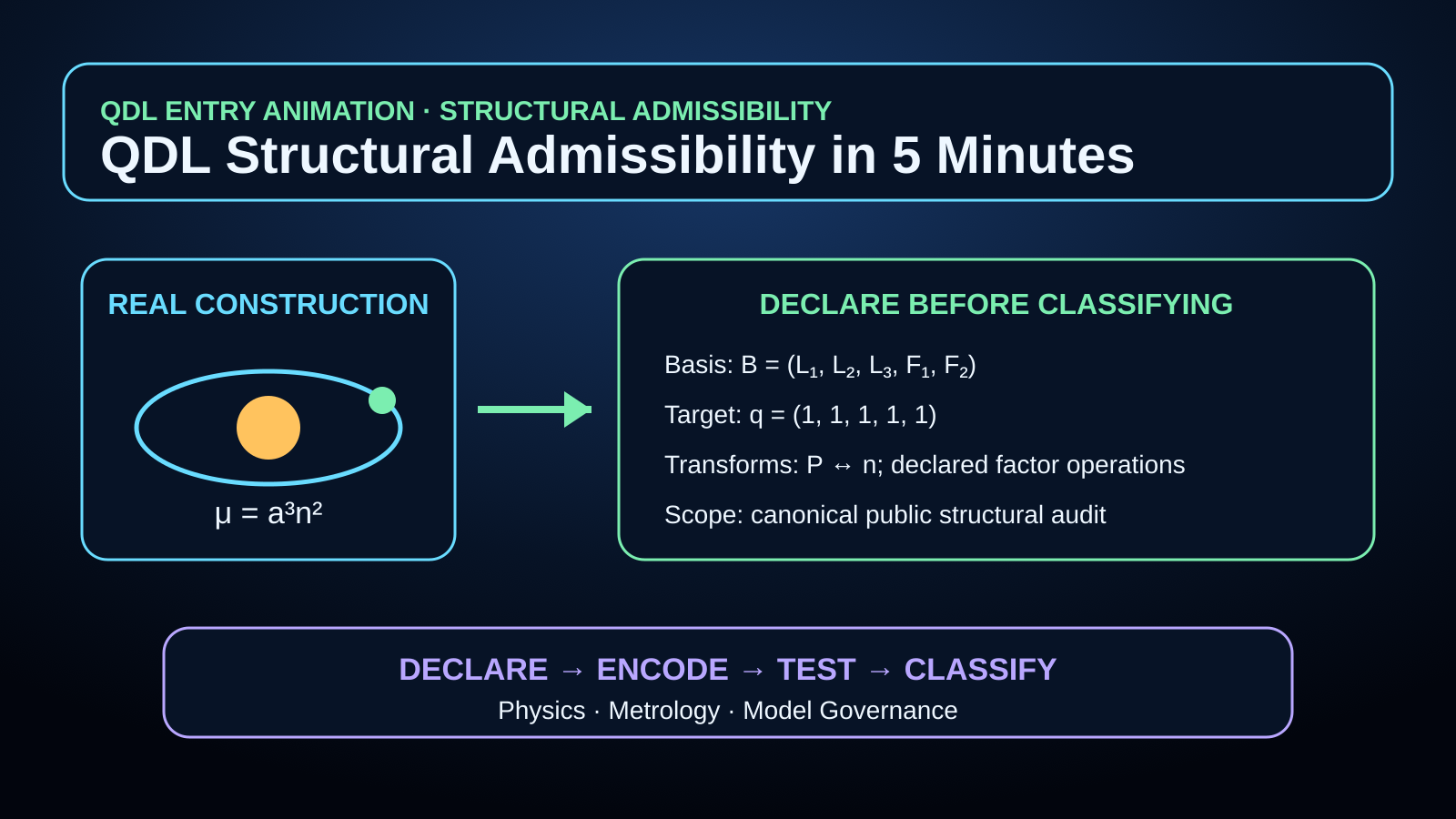
Declare → encode → test → classify
The animation introduces the exact workflow used on this page: declare the ledger basis, closure target, allowed transforms, and scope; convert a physical construction into a ledger vector; calculate the closure remainder; and classify the construction as admissible or excluded under the declared rules.
Public-Facing Picture
The QDL Lattice interpretation provides the intuitive substrate picture.
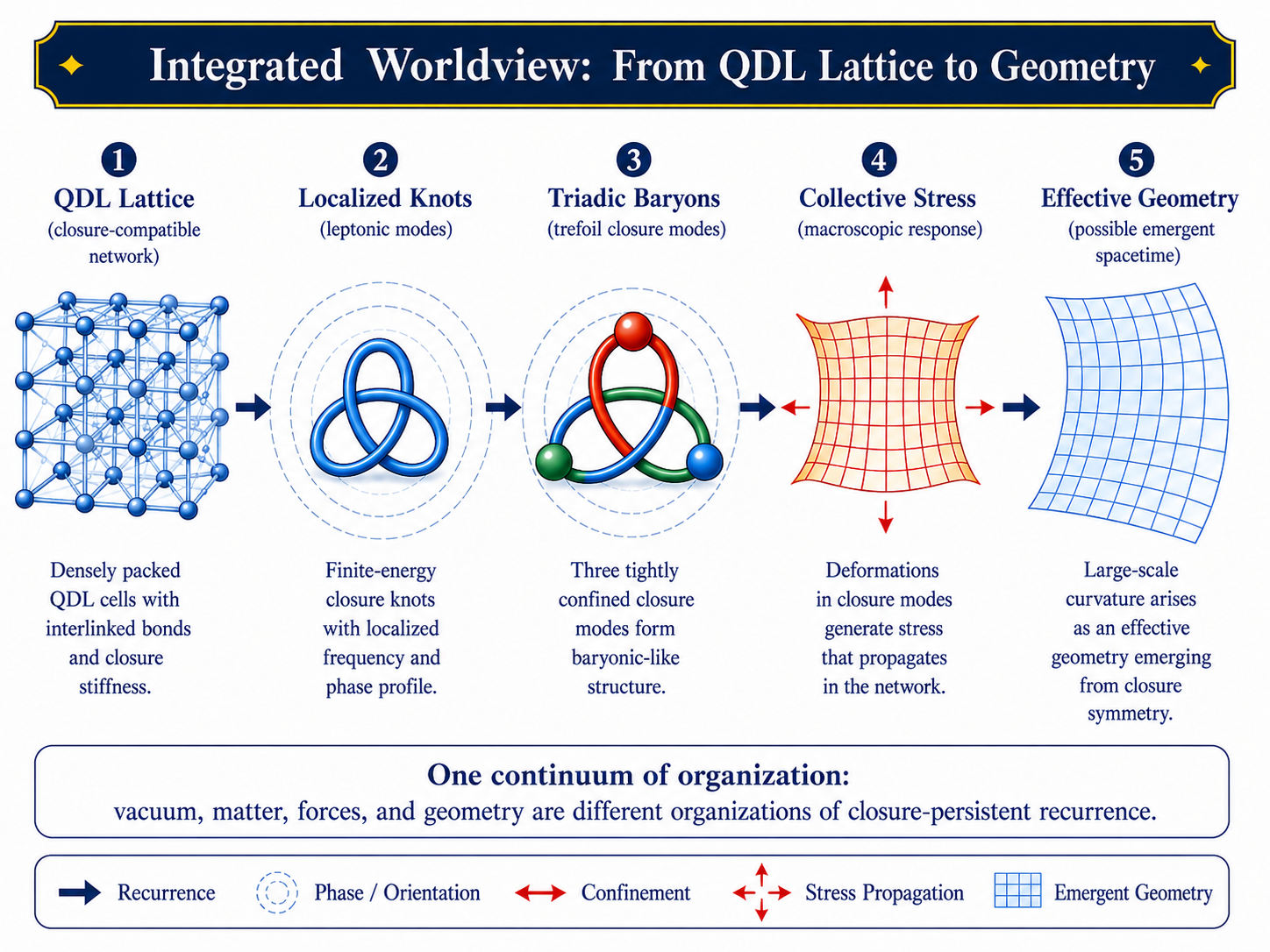
QDL models space not as absolute emptiness, but as a closure-compatible QDL Lattice of recurrence. Particles are persistent localized modes of that same structure, composite particles are confined multi-channel modes, and geometry is investigated as a possible large-scale response of collective closure stress.
Claim-status note: this is a substrate interpretation and research architecture. It is not a claim that microscopic QDL lattice cells have already been directly observed, or that spacetime, spin, gravity, and the full particle spectrum have already been completely derived.
Scope and Status
What is defined here, what is postulated, and what remains downstream.
| Defined framework | Ledger representation in a 3L + 2F basis, a closure-style admissibility predicate, declared transforms, and framework-level output as admissible or excluded. |
| Postulates | Use of a QDC target of the form L³F² and the claim that closure can add constraint beyond ordinary dimensional homogeneity. |
| Applications | Gravity, EFT/SMEFT, metrology, constants, experiments, and executable validation infrastructure are downstream uses of the admissibility layer. |
| Not claimed here | QDL does not replace dynamics, fit data by itself, or constitute evidence for new particles, forces, or effects. |
| Empirical path | Executed residual-first benchmark records and proposed discriminant tests are separated on the Experiments page. |
Definitions
Minimal objects used throughout the framework.
- Ledger basis. A five-component exponent basis ⟨L1,L2,L3,F1,F2⟩ used to encode dimensional quantities as integer vectors.
- Ledger map. A map from a quantity X to an integer vector v(X) = [L1,L2,L3,F1,F2] ∈ ℤ⁵, combined additively under multiplication of quantities.
- QDC target. A designated closure target of the form AQDC ~ L³F².
- Closure predicate. A construction is admissible if its declared ledger sum satisfies a closure rule of the form Σ v(terms) = n · v(QDC) for some integer n, under a declared transform or equivalence set.
- Declared transforms. A specified set of representation changes, reparameterizations, substitutions, or equivalence operations under which admissibility claims are asserted.
- Framework output. The framework-level output is a classification: admissible or excluded under the declared rules. This is not itself an empirical fit.
These are definitions of use, not claims of physical necessity. Stronger physical readings belong to downstream technical papers and tests.
Assumptions and Commitments
The commitments required for QDL to function as an admissibility filter.
- Integer exponent encoding. The relevant model class admits a lattice representation of dimensional quantities in ℤ⁵.
- QDC postulate. A QDC target of the form L³F² is adopted as the closure reference.
- Closure adds constraint. The closure predicate is asserted to be stricter than ordinary dimensional homogeneity for at least some model classes.
- Declared transforms only. Invariance claims are scoped to declared transforms; undeclared invariances are not assumed.
- Interpretation discipline. “Excluded” means excluded by the declared admissibility rule, not automatically empirically false.
- Claim-status discipline. Definitions, postulates, theorem-level results, conditional reconstructions, benchmarks, conjectures, and proposed experiments must not be collapsed into one claim type.
Core Dimensional Structure
QDL begins with a length-frequency basis and a conserved closure target.
- 3L + 2F length-frequency basis. The framework uses a three-length, two-frequency exponent space rather than a mass-length-time basis.
- Quantized Dimensional Cell. The QDC is the designated closure target: AQDC ~ L3F2.
- Ledger vector representation. Each physical quantity maps to a five-component integer vector, and these vectors combine additively when terms are constructed, multiplied, compared, or transformed.
- Closure-first admissibility. Before fitting or interpreting a construction, QDL asks whether the declared ledger structure survives the operations being performed on it.
Core QDL question Is this construction structurally admissible before we fit, optimize, certify, publish, or deploy it?
From Framework to Physical Interpretation
The next two animations are downstream of the structural screen.
Ledger Closure as an Admissibility Rule
Closure is proposed as a strict pre-fit constraint.
Dimensional homogeneity asks whether expressions have compatible units. QDL asks a stricter structural question: whether the declared exponent structure closes onto a QDC target under the allowed transforms.
- Ledger-closure principle. Admissible constructions must close onto the QDC target, not merely look dimensionally homogeneous after projection.
- Declared equivalences. Any transformation, substitution, basis change, or representation shift must be explicitly declared before closure is evaluated.
- Framework-level consequence. If closure holds, it can be used as an admissibility filter before more detailed dynamical or phenomenological work.
- Failure classification. If closure fails, the failure can be classified as a model failure, transform failure, missing compensator, unsupported extrapolation, or scope error.
If QDL yields operator exclusions, those should be reported only after comparison with canonical operator bases, redundancy handling, and known equation-of-motion or integration-by-parts equivalences.
Constant and unit claims should be treated as a structural taxonomy unless a separate operational or metrological constraint is explicitly derived.
Claim-Status Map
A framework page should prevent overclaiming by design.
| Definition | Ledger basis, ledger map, QDC target, closure predicate, declared transforms, and admissible/excluded output. |
| Postulate | Closure relative to QDC has physical or structural significance beyond ordinary dimensional homogeneity. |
| Strict result | A derivation or exclusion that follows from the declared formal system without additional empirical assumptions. |
| Conditional reconstruction | A result that holds only under declared assumptions, transform choices, sector definitions, or restricted model families. |
| Benchmark | A reproducible methodological test, typically using public or controlled data, that evaluates residual structure or audit logic without claiming a new effect. |
| Proposed experiment | A future discriminant test with explicit success and failure conditions. |
| Open gate | A task that must be closed before QDL can claim completion in that sector, such as full gravity recovery, absolute masses, gauge couplings, quarks, neutrinos, CKM/PMNS, dark-sector residuals, or cosmology. |
Structural Positioning
Historical analogies clarify function only; they are not equivalence claims.
| Historical precedent | Structural role | QDL analog |
|---|---|---|
| Maxwell | Field-level structural unification | Ledger closure as a unified admissibility grammar |
| Einstein | Constraint structure replaces a looser formulation | Closure filters admissible constructions before interpretation |
| Dirac | Formal structure constrains allowed content | Lattice organization constrains representable constructions |
| Standard Model | Symmetry restricts interactions | Ledger closure restricts admissible dimensional structure |
These analogies clarify the type of role QDL would play if successful as an admissibility layer. They do not imply comparable maturity, status, or validation.
Falsification Boundaries
QDL claims must be tied to declared transforms, model families, and failure conditions.
- Closure falsification. If a declared class of empirically adequate models repeatedly violates closure under the declared transform set, and those violations cannot be removed by the declared equivalences, the closure claim fails for that model class.
- Constraint-content falsification. If a supposed QDL-specific exclusion reduces entirely to already-known redundancy elimination, QDL has not added new constraint content for that case.
- Experimental falsification. If a pre-stated QDL-distinct scaling signature is not observed within the stated sensitivity under a pre-registered analysis plan, that specific experimental claim fails.
- Benchmark falsification. If QDL cannot reproduce or classify known admissible and inadmissible cases under its own rules, the benchmark claim weakens or fails.
- Overclaim falsification. If a conditional branch is presented as a theorem, or a benchmark record is presented as a new physical effect, the claim-status discipline fails.
Detailed benchmark records and proposed discriminant tests are maintained on the Experiments page.
Application Layers
Applications are downstream of the admissibility framework.
Metrology and Constants
QDL supports structured dimensional audits for units, constants, measurement chains, QMU ledgers, and the ontology of physical constants.
Peer-reviewed anchor: JTAP metrology article.
Operator Governance
Expressing EFT and SMEFT operator content in ledger form yields an integer lattice in which closure can be tested as an additional admissibility constraint.
Dataset: SMEFT Γ(O) Audit Companion.
Toroidal QDC and Substrate
The toroidal QDC branch develops a compact closure-space geometry and QDL Lattice interpretation as a conditional substrate architecture.
Keystone: Toroidal QDC Knot.
QDC Completion Theorem
The completion spine organizes matter-basis minimality, primitive three-family recurrence, charged-lepton closure, gravitational recurrence, and open proof gates.
Record: QDC Completion Theorem.
Experiments and Benchmarks
Executed residual-first benchmark records and proposed laboratory discriminants test whether QDL adds reproducible structure beyond ordinary bookkeeping.
Start at Experiments.
Executable Validation
QDL can be implemented as machine-executable validation infrastructure for measurement pipelines, scientific software, AI-output checking, sensor fusion, and digital twins.
Prototype Demo
A minimal static example of the structural screen.
The prototype demo shows how a model pipeline can be screened for structural admissibility before calibration and deployment, including a workflow diagram and example integrity report.
This demo illustrates the structural screen. It is not a full software implementation.
Recommended Reading Order
Use this path to avoid starting in the most technical branches.
- QDL Structural Admissibility in 5 Minutes
- QDL in 5 Minutes
- QDL/QDC Planck-Scale Worldview
- From GM to the QDC
- Framework
- Experiments
- Physical Law as the Minimal Architecture of Persistence Under Closure
- From Closure Admissibility to Physical Selection
- The Quantized Dimensional Ledger for Metrology
- Publications
Quick-Start Summary
The shortest accurate description of the framework.
QDL is a closure-based admissibility framework. It represents quantities as integer ledger vectors, declares a QDC target, and tests whether proposed constructions close under specified transforms.
The framework is designed to act upstream of fitting, simulation, certification, and interpretation. Its near-term test is whether it can repeatedly identify, classify, or constrain structures that ordinary dimensional bookkeeping does not make explicit.
Bottom line QDL asks whether a construction is dimensionally and representationally coherent before major effort is invested in fitting, interpretation, certification, or deployment.