
QDL Physics Institute
The QDL Physics Institute is an independent research institute based in Huntley, Illinois, USA. It develops the Quantized Dimensional Ledger (QDL) and Quantized Dimensional Cell (QDC) research program in primitive closure, structural admissibility, physical completion, metrology, reproducible computational physics, falsification, and scientific validation.
The Institute's central research question is whether a closure-first structural architecture can do more than organize dimensional relations: whether it can progressively constrain physical dynamics, particle capacity, quantum consistency, gravity, and predictive observables.
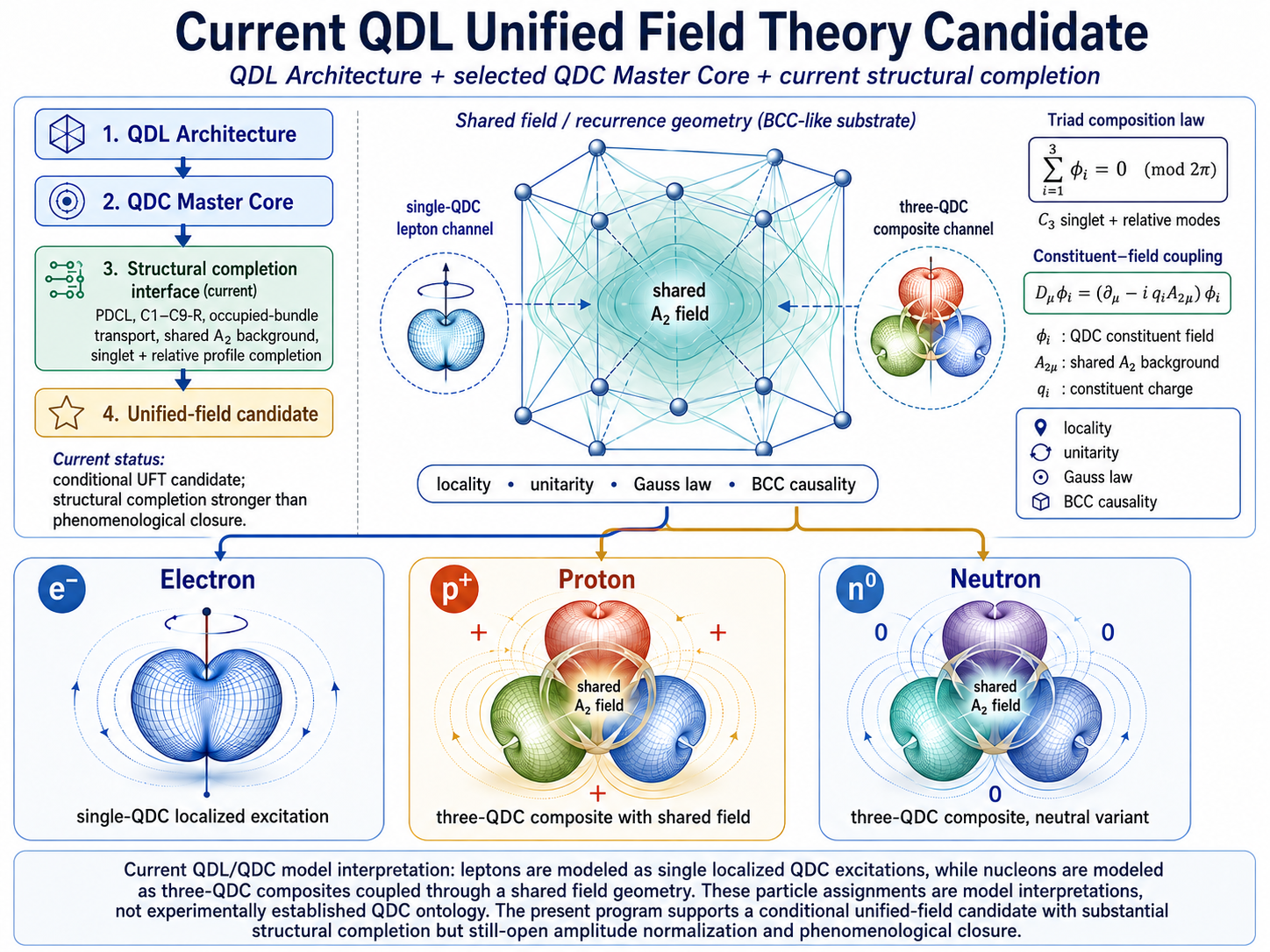
The present QDL/QDC physical program is described as a conditional unified-field candidate undergoing a formal Completion-Gate Series . It is not presented as a completed or experimentally confirmed unified field theory.
From Primitive Closure to Physical Completion
QDL began as a framework for treating dimensional structure as an admissibility problem rather than merely as bookkeeping. The present research program asks whether that structural architecture can be extended into an explicit physical theory through a selected QDC master core, constitutive completion, quantum consistency, prediction, and independent testing.
The Institute's present objective is not to declare that this chain is complete. It is to determine, gate by gate, exactly which links can be proved, computed, uniquely selected, reproduced, falsified, or rejected.
Contact & Identifiers
Primary Institute contact and public research identifiers.
The Institute welcomes serious scientific inquiry, critical review, replication, and collaboration in areas including:
- Dimensional closure and structural admissibility.
- Mathematical and computational foundations of QDL/QDC.
- Independent reproduction of Completion-Gate results.
- Quantum measure and lattice-gauge consistency.
- Particle-capacity and localized-state analysis.
- Gravity and collective-field completion.
- Metrology and measurement-chain integrity.
- Scientific software and validation infrastructure.
- Blind prediction and independent experimental replication.
Current QDL/QDC Research Architecture
The present visual summary of the physical-completion program.
Current Major Public Records
Three primary anchors for understanding the present Institute research program.
Primitive Closure and the Architecture of Physical Admissibility
The major long-form synthesis of primitive closure, structural admissibility, QDL/QDC architecture, recurrence, physical completion, gravity, particle capacity, and open research gates.
Toward a QDL Unified Field Theory
Frozen consolidated record of the current architecture, computational gates, reproducibility results, claim boundaries, and open physical-closure problems.
The Quantized Dimensional Ledger for Metrology
Peer-reviewed journal foundation for dimensional closure, QMU ledgers, and the ontology of physical constants.
Mission
Closure-first research with explicit proof, computation, falsification, and claim boundaries.
The Institute's mission is to:
- Develop QDL as a mathematically explicit theory of dimensional closure and structural admissibility.
- Determine which physical structures follow from closure and which require additional completion assumptions.
- Develop explicit QDC recurrence, field, localized-state, and composite-state models.
- Investigate whether one coherent completion architecture can connect matter, interactions, quantum consistency, and gravity.
- Distinguish structural completion from unresolved amplitude and normalization selection.
- Produce predictions that are not separately inserted into the construction.
- Design blind, reproducible, independently testable calculations and experiments.
- Preserve negative results and failed selectors as part of the scientific record.
- Publish open, DOI-backed research and reproducibility archives.
The Institute also investigates whether the structural admissibility methodology can provide useful validation tools independently of the strongest QDL/QDC fundamental-physics claims.
- Metrology and physical-constant interpretation.
- Measurement-chain integrity.
- Model pre-verification.
- Scientific software validation.
- EFT / SMEFT operator auditing.
- AI-generated scientific-output checking.
- Sensor-fusion and digital-twin validation.
- Reproducible benchmark architecture.
Research Principles
The procedural commitments guiding the current program.
Program Architecture
Four connected layers define the current Institute research program.
Primitive closure, typed dimensional ledgers, structural admissibility, representation rules, residual structure, and the mathematical QDL architecture.
QDC master core, constitutive completion, particle capacity, collective fields, gravity, vacuum structure, and amplitude normalization.
Completion gates, quantum-measure tests, blind predictions, model fingerprints, experimental discriminants, and independent replication.
Metrology, measurement integrity, scientific software, AI-output checking, operator audits, model validation, and executable admissibility systems.
Founder & Research Profile
Independent program leadership and public research record.
James D. Bourassa is the Founder and Director of the QDL Physics Institute and developer of the Quantized Dimensional Ledger research program.
The research follows a closure-first ordering: formalize the admissible representation, determine what follows structurally, build explicit dynamical carriers, identify remaining completion assumptions, and then subject candidate physical consequences to computational and empirical gates.
The present program spans dimensional ontology, structural admissibility, QDL/QDC architecture, particle-capacity models, gravitational completion, quantum-measure consistency, predictive physics, metrology, and scientific validation infrastructure.
QDL is not framed as a replacement for established quantum field theory, general relativity, metrology, statistics, or experiment.
The research asks whether closure and admissibility provide an additional structural layer capable of selecting or excluding physical constructions before downstream fitting.
Where the QDL/QDC program makes stronger claims about fundamental physics, those claims are separated into explicit theorem, completion, quantum, predictive, and replication gates.
Open Research Practice
Public archiving is treated as part of the research method.
Permanent research records
Major manuscripts, datasets, computational companions, and completion archives are deposited in public repositories with permanent DOI identifiers.
Frozen snapshots
Major records are treated as historical snapshots. Later scientific progress is reported through new versions, new archives, or the living Research Program page rather than silently rewriting earlier evidence.
Reproducibility records
Where feasible, source code, computational outputs, manifests, checksums, verification scripts, and frozen gate specifications accompany the research record.
Institutional Research Status
High-level status only; the Research Program page carries the technical chronology.
| Institute status | Independent research institute developing QDL/QDC in foundations of physics, metrology, structural admissibility, reproducibility, and scientific validation. |
| Peer-reviewed foundation | QDL has a peer-reviewed metrology anchor in the Journal of Theoretical and Applied Physics. |
| Major synthesis | Primitive Closure and the Architecture of Physical Admissibility is the principal current long-form synthesis. |
| UFT status record | Toward a QDL Unified Field Theory provides the frozen V1.0 consolidated theorem, gate, reproducibility, and open-problem record. |
| Current physical status | Conditional unified-field candidate with substantial structural completion and unresolved amplitude, quantum, phenomenological, and empirical closure. |
| Live research process | The Completion-Gate Series continues to test outstanding mathematical and physical requirements under frozen, failure-sensitive criteria. |
| Independent confirmation | Unaffiliated replication and a distinctive experimentally confirmed QDL/QDC prediction remain open objectives. |
Selected 2026 Milestones
Major public and institutional developments in the current program.
QDL Metrology Foundation Published
The Quantized Dimensional Ledger for Metrology: Dimensional Closure, QMU Ledgers, and the Ontology of Physical Constants established the first peer-reviewed journal anchor for QDL.
Primitive Closure Published
Primitive Closure and the Architecture of Physical Admissibility was released on Zenodo as the major long-form synthesis of the QDL architecture and physical-completion program.
Consolidated UFT V1.0 Record Released
Toward a QDL Unified Field Theory consolidated current theorems, computational gates, reproducibility records, claim boundaries, and open physical-closure problems.
Unified Field Theory Completion-Gate Series
The research program is now explicitly organized as a preregistered, fail-closed completion sequence across architecture, dynamics, particle capacity, quantum consistency, gravity, prediction, and replication.
Structural-to-Dynamical Completion Archive
The theorem, audit, reproducibility, and falsification archive was released as a permanent public record of the physical-completion program.
Structural-Admissibility Validation Direction
The Institute has developed an applied infrastructure direction for structural-admissibility validation of physical measurement and modeling pipelines.
U.S. Provisional Patent Application No. 64/055,985: Systems and Methods for Structural Admissibility Validation of Physical Measurement and Modeling Pipelines .
Collaboration & Scientific Scrutiny
Independent checking is a central next step for the program.
The QDL Physics Institute welcomes collaboration and critical engagement from researchers, mathematicians, physicists, computational scientists, experimental groups, metrology laboratories, editors, reviewers, scientific-software developers, and validation organizations.
Particularly valuable forms of engagement include:
- Independent checking of mathematical proofs and derivations.
- Independent execution of frozen computational gates.
- Replication of published QDL/QDC model fingerprints.
- Review of chiral-measure and lattice-gauge constructions.
- Alternative derivations of unresolved completion selectors.
- Precision experiments capable of testing distinctive predictions.
- Metrology and measurement-chain pilot applications.
- Scientific-software validation studies.
- Operator-audit and effective-theory comparisons.
- External evaluation of practical structural-admissibility tools.
For scientific correspondence, collaboration, replication, or institutional discussion: james.bourassa@qdlphysics.org .
Research Support
Support can strengthen open verification rather than merely expand claims.
The Institute welcomes philanthropic, institutional, computational, and collaborative support that helps expand the verification capacity of the research program.
High-value support areas include:
- Independent mathematical review.
- External computational replication.
- High-performance numerical work on frozen Completion Gates.
- Experimental testing of preregistered QDL/QDC predictions.
- Open research archiving and reproducibility infrastructure.
- Development and validation of structural-admissibility software.
- Scientific communication and public-access research materials.
Support does not alter the Institute's claim-status policy: theoretical, computational, and experimental claims remain subject to the same declared success and failure criteria.
QDL Physics Institute Site Guide
Seven pages, each with a distinct role.
Home
Main public overview, major announcements, and current research highlights.
QDL in 5 Minutes
Accessible introduction to primitive closure, QDL, QDC, and the current unified-field completion program.
Research Program
Authoritative living technical status, Completion-Gate Series, major results, and open problems.
Publications
Peer-reviewed work, monographs, datasets, Zenodo archives, and complete DOI-backed publication record.
Resources
Reproducibility archives, computational companions, graphics, benchmarks, tools, and supporting materials.
Benefits
Potential applications of structural admissibility in metrology, modeling, software, AI, engineering, and scientific validation.
QDL/QDC has developed a substantial architecture, an expanding physical-completion program, reproducible computational gates, explicit particle and gravity capacity, and a growing public evidence record.
The remaining task is the decisive one: determine which parts are mathematically necessary, which require additional physical input, which generate genuinely distinctive predictions, and which survive independent scrutiny.
Until those requirements are met, the Institute describes QDL/QDC as a conditional unified-field candidate , not as completed fundamental physics.