
QDL/QDC Unified Field Theory Completion-Gate Series
The QDL research program is now organized around a formal Completion-Gate Series asking whether the Quantized Dimensional Ledger architecture and selected QDC master core can be completed into a physically predictive unified-field theory.
The strongest present formulation is:
The program currently contains substantial structural completion, explicit finite-model dynamics, particle-capacity constructions, conditional gravitational universality, a technically advanced quantum-measure program, and a reproducibility/falsification record. It does not yet contain a uniquely normalized parent theory, a completed particle phenomenology, or an experimentally confirmed distinctive QDL prediction.
This page is the living research-status record. The Zenodo V1.0 consolidated archive is a frozen historical snapshot through QDL-QM5R3G; the active website status has progressed through QDL-QM5R3O, with QDL-QM5R3P preregistered as the next quantum-measure gate.
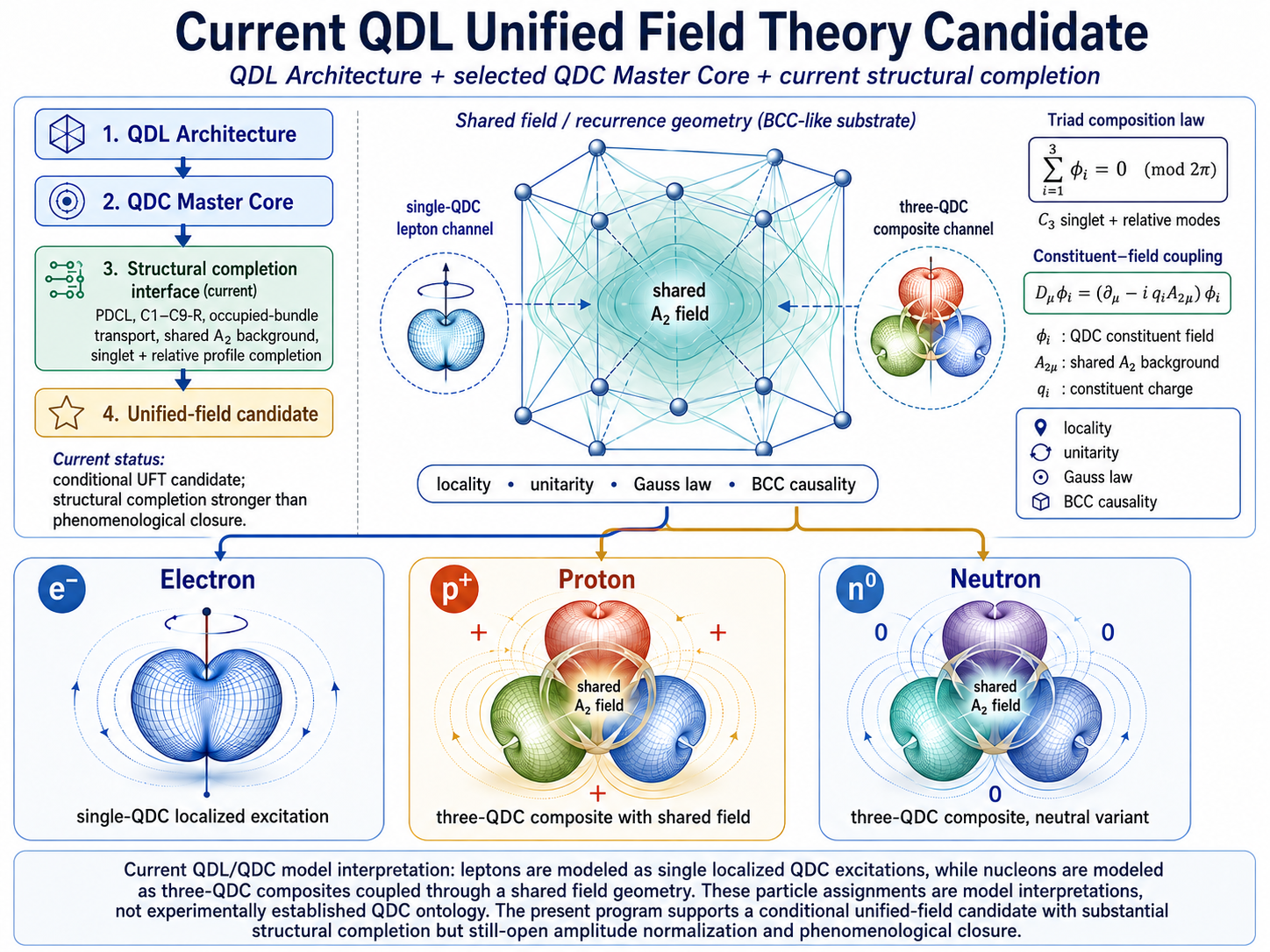
The present QDL/QDC unified-field candidate
The current architecture separates the QDL structural layer, the selected QDC master core, the structural completion interface, and the still-open physical completion problems. The particle images below are model-level interpretations of the present single-QDC and three-QDC construction.
Current Status by Layer
Strongest positive result and present hard boundary.
| Layer | Current status | Strongest positive point | Hard boundary |
|---|---|---|---|
| Architecture / representation | Substantial conditional structure | Typed 3+2 closure architecture and explicit representation/admissibility framework | Not an assumption-free derivation of all observed physics |
| QDC master core / structural completion | Executable finite-model carrier; numbered constitutive rank 9 | Local/reversible carrier and structural completion through PDCL and C1–C9-R | C10-X not admitted; amplitude layer unresolved |
| Particle capacity | Multiple explicit localized and composite constructions | Projective internal dynamics, compact closure-flux defect, gauge dressing, and triadic composite capacity | Complete observed-particle identification, phenomenology, and exchange statistics remain incomplete |
| Gravity | Conditional Einstein–Cartan / GR universality | Two local tensor modes under declared completion assumptions | Unique Lorentz vacuum, G, Λ, and gravitational normalization not selected |
| Predictive / empirical | Replication route selected | CORE8A zero–π operator fingerprint frozen and blinded | No externally confirmed nature-level distinctive QDL winner |
| Quantum measure | Strong structural and computational progress | Exact determinant-line formulation, continuum connection, finite source-space reduction, and complex Riesz-strip advances | Canonical-chart certification remains open before the continuum L=4 atlas can be authorized |
| Unified-field status | Conditional UFT candidate | Architecture and structural completion are increasingly integrated | A unique amplitude-normalized parent theory has not yet been obtained |
The Current Completion Boundary
Structural completion and amplitude completion are now treated separately.
Pstructural
The structural completion layer contains the accumulated occupation, transfer, response, composition, placement, shared-field, orientation, and relative-profile rules used by the current QDL/QDC finite models.
The numbered constitutive registry presently has rank 9, through C9-R.
Pamplitude
The amplitude layer would have to select physically meaningful cross-sector coefficient ratios, absolute normalization, matter–gravity normalization, and related coupling information.
The V49 boundary result found no new certified reduction of this amplitude freedom from the accumulated architecture and structural completion stack.
The distinction is important: a highly constrained structural theory is not automatically a uniquely normalized fundamental theory. Phase III can still produce an executable theory with finite empirical calibration and blind predictions, while the stronger UFT target seeks to derive the normalization structure itself.
Quantum-Measure Completion-Gate Series
How the present quantum-measure obstruction has progressively narrowed.
Exact determinant-line / Fredholm identity
Established an exact closed-projector representation of one-dimensional determinant-line holonomy and eliminated arbitrary occupied-frame gauge choices.
Certified rational projector
Produced a rigorous rational sign-projector approximation, but the original spatial-buffer compression strategy failed to achieve the required phase tolerance.
Finite-rank resolvent-defect engine
Replaced the failed spatial-buffer route with a low-rank Woodbury/resolvent formulation and obtained sub-10⁻⁶ phase agreement on the frozen L=4 controls.
Complete finite-node L=4 census
Completed the discrete L=4 atlas and exact symmetry reductions, but winding refinement revealed that the finite-node result was not yet the continuum Kato holonomy.
Direct continuum determinant-line connection
Established second-order projector-polygon convergence and derived the direct canonical continuous connection formula, bypassing brute-force winding extrapolation.
Analytic projector derivative and source determinant
Built the analytic rational P′ formulation and exposed the finite-source Laurent structure controlling complex-winding singularities.
Source-rational-Krylov reduction
Removed the ambient-rank bottleneck by representing the relevant projector corrections inside a fixed finite source space. The complex-strip problem was also reformulated correctly as Riesz-contour separation rather than a zero-energy-only condition.
Annulus / Riesz dimensional reduction
Reduced the three-variable no-singularity problem to the two annulus boundaries plus an analytic large-|ω| tail. The first fully certified complex Riesz strip passed on a frozen hypercharge control.
Laurent root-tube continuation
Replaced pessimistic matrix-box enclosures with normalized scalar Laurent root continuation. The difficult weak and large-QL controls became tractable, moving the controlling obstruction from Riesz separation to the canonical chart.
Current Frontier: Canonical-Chart Certification
The present quantum-measure obstruction is no longer primarily raw matrix size, finite-volume scaling, or the existence of a Riesz strip. The active proof obligation is to certify that the analytically continued occupied subspace remains in a valid canonical chart throughout the required complex strip.
QM5R3P is preregistered around an invariant-graph / algebraic Riccati formulation. Instead of bounding the chart indirectly through a pessimistic global projector norm, the occupied subspace is represented directly as a graph over the base occupied subspace.
L=6 remains locked. The continuum L=4 phase atlas is not authorized until the chart, Krylov error, Riesz separation, and quadrature bounds are all certified under the frozen gate rules. L=8 remains unauthorized.
Strongest Positive Results
Results presently carrying the most weight inside the program.
Typed structural closure
A coherent 3+2 representation/admissibility architecture can be audited as a mathematical selection framework.
Executable QDC master core
The program contains explicit local and reversible finite recurrence/operator carriers rather than only qualitative substrate language.
Projective internal dynamics
Frozen localized channels support non-Abelian Kato/Wilczek–Zee response and exact first-order projective internal dynamics.
Stable compact closure-flux defect
The frozen model contains integer charge, finite energy, stability modulo gauge/harmonic zero modes, and controlled long-range dressing.
Conditional GR universality
Under declared Lorentz-orbit, coframe, sign, torsion, and higher-curvature assumptions, the collective theory enters Einstein–Cartan/GR universality with two local tensor modes.
CORE8A zero–π fingerprint
A frozen, operator-protected no-fit spectral pairing has been selected for blinded external replication. External unaffiliated execution remains pending.
Exact determinant-line formulation
The QM5R3 series now contains exact Fredholm/projector identities, direct continuum connection formulas, and finite source-space representations.
Riesz-strip certification
Annulus/root-count and Laurent root-tube methods have turned parts of the complex-winding analyticity problem into source-space certification tasks.
Peer-reviewed foundation
The dimensional-closure and QMU-ledger layer has a published peer-reviewed anchor in the Journal of Theoretical and Applied Physics.
Open Physical-Closure Problems
The main problems separating the current candidate from a completed physical UFT.
Claim-Status Firewall
What this research page does and does not imply.
Positive program-level claims
The program contains exact mathematical results, reproducible finite-model computations, explicit structural completion laws, localized/composite model capacity, conditional gravity results, and a progressively narrowing quantum-measure completion program.
These results may be stated at their demonstrated level and under their declared assumptions.
Strong claims still prohibited
QDL is not presently claimed to be a completed final theory, to derive every Standard Model parameter, to uniquely derive G or Λ, to establish microscopic QDC particle ontology, or to possess an externally confirmed distinctive prediction.
A failed strong gate remains a failed strong gate even when it produces useful mathematics or a clearer next problem.
Frozen Zenodo Snapshot vs. Living Research Status
Toward a QDL Unified Field Theory: Consolidated Theorems, Computational Gates, Reproducibility Records, and Open Physical-Closure Problems is Version V1.0 of the frozen public record. Its scientific cutoff is QDL-QM5R3G on August 10, 2026.
This website is the living status layer and may therefore report subsequent Completion-Gate progress without altering the historical V1.0 archive. The current live frontier is through QDL-QM5R3O, with QDL-QM5R3P preregistered next.
Major Public Evidence Record
Primary citable anchors for the present research program.
Toward a QDL Unified Field Theory
Consolidated theorems, computational gates, reproducibility records, claim-strength ledgers, and open physical-closure problems.
Primitive Closure and the Architecture of Physical Admissibility
Comprehensive long-form synthesis of primitive closure, physical admissibility, QDL/QDC architecture, completion physics, and open research gates.
QDL Structural-to-Dynamical Completion Program
Theorem, audit, reproducibility, and falsification archive underlying the structural-to-dynamical completion program.
QDL/QDC Computational Companion I
Public computational companion for finite closure ledgers, recurrence structures, QDC balance, and related reproducibility controls.
The Quantized Dimensional Ledger for Metrology
Peer-reviewed QDL foundation for dimensional closure, QMU ledgers, and the ontology of physical constants.
Publications & Research Archives
Browse the complete publication, Zenodo, manuscript, monograph, and dataset record.
Continue Exploring
Use the seven-page site structure for different levels of detail.
QDL in 5 Minutes
Public introduction to QDL/QDC, primitive closure, structural admissibility, and the physical picture.
Publications
Peer-reviewed papers, major monographs, datasets, Zenodo archives, and manuscript record.
Resources
Research archives, graphics, reproducibility packages, and supporting materials.
Institute
Research mission, open-science philosophy, author information, and contact details.