Resources

Program Resources

This page collects supporting materials for the QDL research program, including the canonical QDL roadmap, the JTAP metrology foundation, the QDL substrate capstone, the Toroidal QDC Knot geometric substrate keystone, the QDC Completion Theorem, the SMEFT Γ(O) audit companion, the charged-lepton / mass-spectrum sequence, Core Closure Sequence access, prototype demonstrations, books, benchmark access points, executable validation infrastructure, and reader-facing materials that support orientation, auditability, and technical review.

```

Recommended path: canonical QDL roadmapJTAP metrology foundationQDL Substrate CapstoneToroidal QDC KnotQDC Completion TheoremSMEFT Γ(O) Audit Companioncharged-lepton / mass-spectrum sequence.

Canonical QDL roadmap JTAP metrology foundation QDL substrate capstone Toroidal QDC Knot QDC Completion Theorem SMEFT Γ(O) audit companion Mass-spectrum sequence Core Closure Sequence Prototype demo Books Benchmark access QDL–SO10–1 GUT series QDL Measurement Integrity Engine Patent-pending infrastructure
```

Program Capstone Access

The program-level reference for QDL as a closure-admissibility theory of physical persistence.

```
QDL Substrate Capstone
Program capstone · Physical persistence · Substrate-as-residue interpretation
Physical persistence Compton–gravity threshold Mass-ratio closure Vacuum filtering Measurement-chain closure EFT audits

The current QDL program capstone is Planck-Scale Fluctuation Closure as the Substrate Interpretation of the Quantized Dimensional Ledger: A QDL Capstone on Physical Persistence, Compton–Gravity Thresholds, Mass-Ratio Closure, Vacuum Filtering, and EFT Audits .

This record defines QDL as a residual-first closure-admissibility theory of physical persistence. The substrate is not treated as a mechanical medium, classical aether, or hidden substance; it is defined as the closure-persistent residue of candidate Planck-scale fluctuation structure.

This capstone serves as the organizing reference for the broader QDL program. The Core Closure Sequence supplies the technical records, while the capstone supplies the shared identity, claim-status discipline, substrate interpretation, and audit logic.

```

Toroidal QDC Knot

The canonical geometric substrate-mode keystone for the QDL program.

```
The Toroidal QDC Knot
Geometric substrate keystone · Two-cycle recurrence · DOI-backed preprint
Toroidal QDC Two-cycle recurrence L³F² Family-class lemma Koide phase Vacuum filtering Quantum geometry
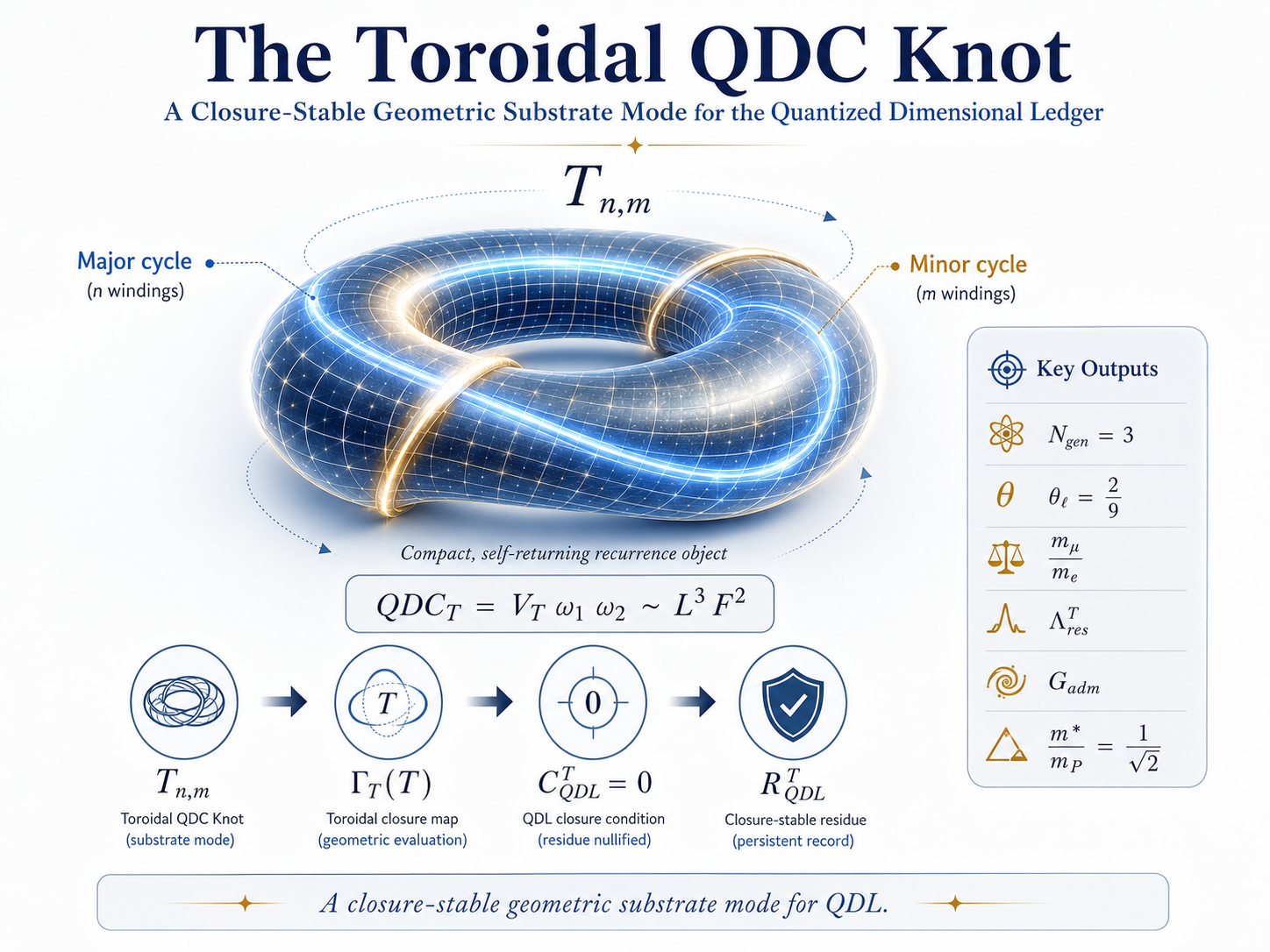
Toroidal QDC Knot graphical abstract showing a compact two-cycle recurrence torus and QDL closure sequence
Graphical abstract for the toroidal geometric substrate keystone.

The canonical QDL geometric substrate-mode record is Bourassa, J. D. (2026). The Toroidal QDC Knot: A Closure-Stable Geometric Substrate Mode for the Quantized Dimensional Ledger (v1.0). Zenodo. https://doi.org/10.5281/zenodo.20367493 .

This paper extends the substrate capstone by proposing a compact geometric persistence object: a toroidal QDC knot with QDCT = VTω1ω2 ∼ L3F2.

Its closure sequence is Tn,m → QDCT → ΓT(T) → CTQDL = 0 → RTQDL. Conditional links include three-family recurrence, the charged-lepton phase θ = 2/9, Koide occupancy-amplitude closure, vacuum residual selection, gauge-sector admissibility, non-SM exclusion, the Compton–gravity threshold, and a candidate toroidal QDC Hilbert space.

Scope note: this is a conditional geometric substrate hypothesis. It does not claim a completed derivation of the Standard Model, a full quantum gravity theory, a numerical derivation of the cosmological constant, or a final solution to dark matter, inflation, black-hole microstates, or time.

```

QDC Completion Theorem Access

The completion-theorem spine connecting the toroidal QDC substrate to Standard-Model admissibility and open proof gates.

```
The QDC Completion Theorem
Completion-theorem spine · Standard-Model admissibility · Open-gate map
Completion theorem Matter-basis minimality Three-family automorphism Charged-lepton closure Gravitational recurrence Open proof gates
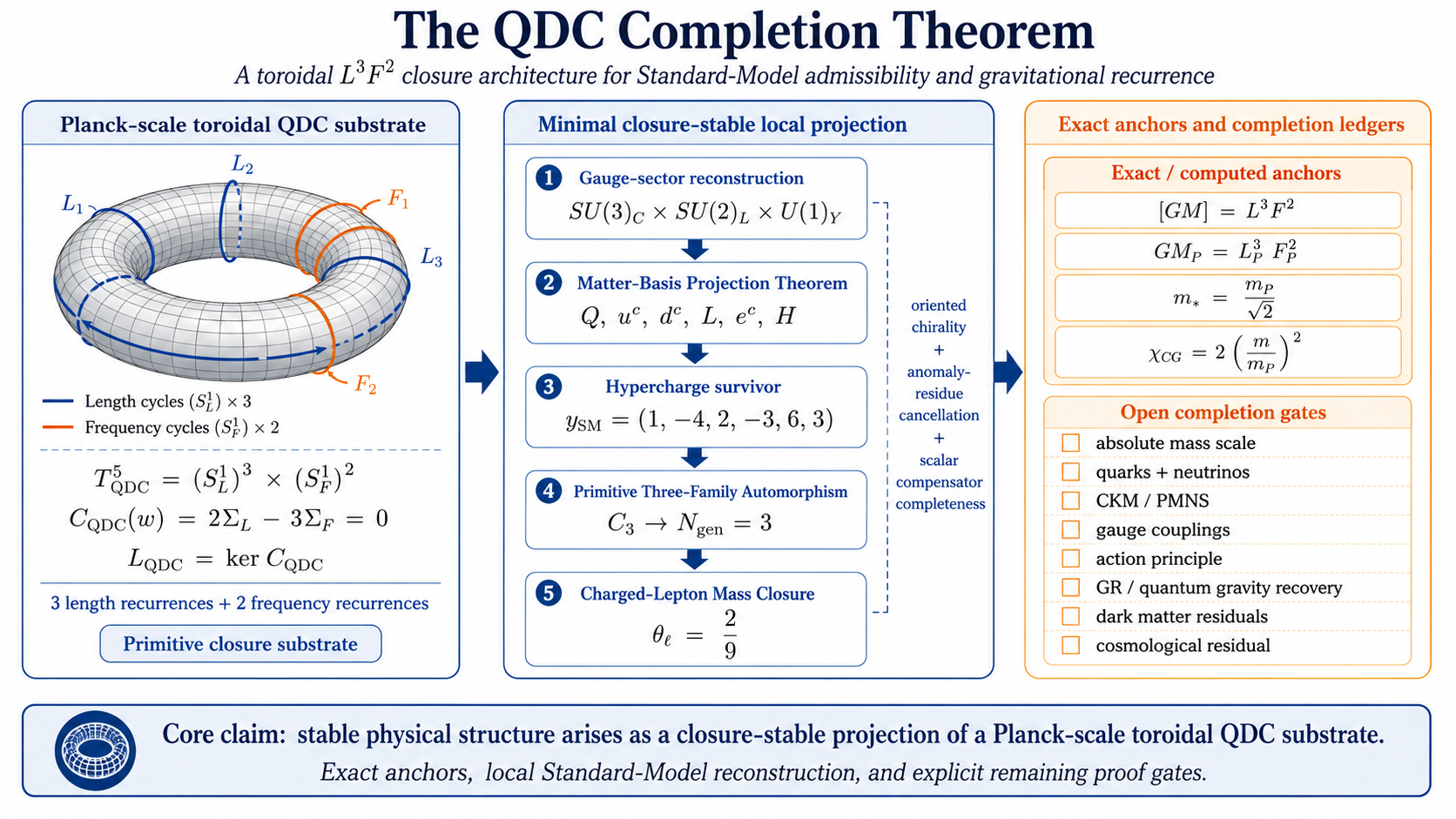
QDC Completion Theorem graphical abstract showing the Planck-scale toroidal QDC substrate, minimal closure-stable Standard-Model projection, exact anchors, and open completion gates
Graphical abstract for the QDC Completion Theorem. The figure separates exact or computed anchors from conditional Standard-Model reconstruction steps and explicitly open completion gates.

The current QDL completion-theorem spine is Bourassa, J. D. (2026). The QDC Completion Theorem: Matter-Basis Minimality, Three-Family Automorphism, Charged-Lepton Closure, and Gravitational Recurrence in the Quantized Dimensional Ledger (v1.0). Zenodo. https://doi.org/10.5281/zenodo.20692677 .

This record consolidates the route from the Planck-scale toroidal QDC substrate to local Standard-Model admissibility and gravitational recurrence. It organizes QDL around exact anchors, conditional reconstruction gates, and explicit remaining proof targets.

Scope note: the theorem does not claim that every Standard Model constant has been computed. It identifies the finite gates that must close for QDL to become a candidate substrate-level completion theory: matter-basis minimality, primitive three-family recurrence, charged-lepton phase closure, mass-scale completion, gauge-coupling normalization, an action principle, gravity recovery, dark-sector residuals, and cosmological residuals.

```

SMEFT Γ(O) Audit Companion

The first machine-readable technical companion dataset to the QDL substrate capstone.

```
QDL SMEFT Γ(O) Audit Companion v1.0
Zenodo dataset · Representative source-anchored audit subset · DOI-backed companion artifact
SMEFT Γ(O) Warsaw basis Operator assignments Exact/source-anchored rows Strict-zero targets Compensator targets Verification taxonomy

The QDL SMEFT Γ(O) Audit Companion v1.0 is a machine-readable dataset and technical companion to the QDL substrate capstone: Bourassa, J. D. (2026). QDL SMEFT Γ(O) Audit Companion v1.0: A Representative Source-Anchored Subset for Closure-Vector Classification of Warsaw-Basis Operator Mixing (v1.0) [Data set]. Zenodo. https://doi.org/10.5281/zenodo.20357001 .

The package includes representative Warsaw-basis operator assignments, exact/source-anchored audit rows, row-level extraction scaffolds, strict-zero and compensator targets, a verification taxonomy, data dictionary, changelog, sources table, README, workbook, and package ZIP.

Scope note: this v1.0 record is a representative source-anchored audit subset and scaffold. It does not claim completion of the full 2499 × 2499 three-generation SMEFT anomalous-dimension matrix, and it asserts no confirmed R-class violations.

```

Mass-Spectrum Resources

The numerical spectrum application layer of the QDL program.

```
Charged-Lepton / Mass-Spectrum Sequence
Numerical spectrum application · Koide closure · Relational phase structure
Mass occupancy Koide cone θℓ = 2/9 Muon–electron mass ratio Toroidal interpretation Completion-gate target

A current synthesis record is QDL Charged-Lepton Mass Spectrum: A Synthesis of Derived Structure and Phenomenological Radial Closure .

The mass-spectrum sequence develops occupancy-amplitude closure, Koide charged-lepton geometry, relational phase quantization, and charged-lepton mass-ratio reconstruction.

This sequence is best read after the substrate capstone, Toroidal QDC Knot, and QDC Completion Theorem. The completion theorem identifies the charged-lepton phase, radial scale, quark, neutrino, CKM/PMNS, and gauge-coupling tasks as explicit open or conditional gates.

```

Core Closure Sequence Access

The current primary pathway into the QDL technical record.

```
Start Here: Core Closure Sequence
Current primary technical entry path · DOI-backed research sequence
Roadmap Numerical ledger Spectrum selection Electroweak closure Flavor closure Operator governance Gravity Cosmology Closure grammar QDC realizations Completion gates

The Core Closure Sequence is the central technical access route for the QDL program. It organizes the work around a roadmap and claim hierarchy, numerical ledger checks, technical pillars, residual tests, neutral matching, Compton realization, gravitational QDC recovery, and completion-gate structure.

The earlier lattice, closure-formalism, SMEFT, metrology, and book records remain important, but they are now best read as foundational background to the broader closure-sequence architecture, substrate-capstone interpretation, toroidal geometric keystone, and QDC Completion Theorem.

1. Read

Use the Publications page to follow the seven-anchor hierarchy, Core Closure Sequence, technical pillars, closure grammar papers, QDL–SO10–1 benchmark series, and earlier foundational path.

2. Understand

Use the Research Program page for the conceptual architecture: framework layer, scientific applications, executable infrastructure, residual-first tests, toroidal substrate geometry, QDC completion gates, and application branches.

3. Test

Use the QDL Admissibility Calculator to test declared vectors against closure rules and inspect live examples.

```

Executable Infrastructure

QDL as machine-executable validation infrastructure for physical measurement and modeling workflows.

```
Patent-Pending Structural Admissibility Validation Systems
U.S. provisional patent application filed · Patent pending
Measurement integrity Model validation AI scientific-output guardrails Scientific software analysis Sensor fusion Digital twins

QDL Physics Institute has filed U.S. Provisional Patent Application No. 64/055,985, titled Systems and Methods for Structural Admissibility Validation of Physical Measurement and Modeling Pipelines.

This filing marks the executable infrastructure phase of QDL: applying structural admissibility as a machine-executable validation layer for physical measurement, modeling, simulation, uncertainty analysis, AI-generated scientific outputs, sensor fusion, digital twins, and related technical workflows.

The purpose is practical rather than speculative: to test whether QDL-style ledger mapping, closure checks, audit traces, and downstream workflow controls can identify structural failures that ordinary unit checking or dimensional homogeneity may not detect.

Status: U.S. provisional patent application filed; patent pending.

QDL Measurement Integrity Engine
Executable infrastructure concept · Measurement and modeling validation
Ledger-vector assignment Closure testing Audit traces Certification / warning / rejection Repair recommendation

The QDL Measurement Integrity Engine is an early executable-infrastructure concept for applying structural admissibility checks to physical measurement and modeling pipelines.

The engine is designed to receive a declared measurement or model specification, assign integer-valued ledger vectors to its components, check ordinary projected dimensional homogeneity, apply a QDL closure or admissibility rule, and generate an audit trace with a certification, warning, rejection, or repair recommendation.

The motivating use case is measurement integrity: a model may pass ordinary unit checking while still containing a structurally non-admissible correction, transformation, or hidden dimensionless factor. QDL executable infrastructure is being developed to make such failures auditable.

Status: Prototype direction disclosed in U.S. Provisional Patent Application No. 64/055,985; patent pending.

```

Prototype Demonstration

A static example of how structural admissibility screening can be presented as a workflow.

```
Structural Integrity Screening Workflow
Prototype demonstration
Workflow diagram Example report Pseudo-code Prototype

This resource presents a minimal static demonstration of how a model or pipeline can be screened for structural admissibility before calibration and deployment. It is framed as an illustration of workflow, not as a full implementation.

The live interactive version of this idea now appears in the QDL Admissibility Calculator, while this prototype remains useful as a presentation-oriented workflow artifact.

How to Use This Resource
  • Use it as a conceptual orientation tool, not as a substitute for the formal papers.
  • Read it after the Research Program page if you want to understand workflow implications.
  • Treat it as a presentation artifact for structural screening logic rather than a software release.
  • Use the QDL Calculator when you want a live interactive entry point.
  • Use the QDL Measurement Integrity Engine direction when evaluating applied measurement-integrity and model-validation workflows.
  • Use the SMEFT Γ(O) Audit Companion when evaluating source-anchored EFT/operator-governance tables.
  • Use the QDC Completion Theorem when evaluating the finite completion-gate map.

The demo belongs naturally under framework support material rather than the top-level scientific navigation, which is why it is placed here in Resources.

```

Books & Reader-Facing Material

Longer-form synthesis and reader-oriented entry points for the broader program.

```
Cover of The Quantized Dimensional Ledger
The Quantized Dimensional Ledger: A Structural Framework for Dimensional Coherence in Physics
Book · reader-facing synthesis

This volume functions as a synthetic and accessible presentation of the QDL program, while the formal, canonical claims remain anchored in the DOI-backed paper record.

Book-Level Synthesis

Useful for readers who want the overall architecture and motivation of the program before moving into the technical papers.

Technical Record Remains Primary

The formal mathematical structure and strongest technical claims remain in the DOI-backed papers, datasets, and preprints.

Best Reading Order

Use the seven-anchor hierarchy first. The book remains useful as orientation, but the current canonical program path runs through the roadmap, JTAP foundation, substrate capstone, Toroidal QDC Knot, QDC Completion Theorem, SMEFT audit companion, and mass-spectrum sequence.

```

Scientific Application Resources

Application-layer records that ground QDL concepts in concrete physical domains.

```
QDC in Gravitational Dynamics
Zenodo preprint · QDL scientific application layer
Quantized Dimensional Cell GM Keplerian closure Gravitational parameter Dimensional admissibility

A QDL gravitational dynamics paper identifies the gravitational parameter μ = GM as a direct realization of the Quantized Dimensional Cell form, L3F2, and interprets Keplerian closure as μ = r3ω2 for circular motion and μ = a3n2 for elliptical Keplerian motion.

This paper provides a concrete physical anchor for QDL closure: the QDC is not merely an abstract dimensional form, but appears in the standard structure of orbital mechanics.

Bourassa, J. D. (2026). The Quantized Dimensional Cell in Gravitational Dynamics: GM, Keplerian Closure, and Dimensional Admissibility. Zenodo. https://doi.org/10.5281/zenodo.20026718

Compton / QDC Realization

The Compton realization paper connects quantized dimensional closure to localization-frequency structure and operator sector selection.

DOI: 10.5281/zenodo.20100436

Neutral Matching Unit

The neutral matching paper develops a 1/18 uniqueness theorem from binary–ternary sector coupling, Z6 operator grading, and electroweak residual preservation.

DOI: 10.5281/zenodo.20098523

Closure Sequence Lessons

This synthesis separates strong claims, open residuals, falsification tests, and the emergence of a compact QDL closure grammar.

DOI: 10.5281/zenodo.20098982

SMEFT Operator-Governance Dataset
Machine-readable audit companion · QDL scientific application layer
EFT/operator governance Warsaw basis Closure-vector classification Audit tables

The SMEFT Γ(O) audit companion provides the first source-anchored dataset for applying QDL closure-vector classification to representative Warsaw-basis SMEFT operator-mixing rows.

Bourassa, J. D. (2026). QDL SMEFT Γ(O) Audit Companion v1.0: A Representative Source-Anchored Subset for Closure-Vector Classification of Warsaw-Basis Operator Mixing (v1.0) [Data set]. Zenodo. https://doi.org/10.5281/zenodo.20357001

```

Benchmark Access

Entry points to executed benchmark records and supporting methodological materials.

```
Benchmarks & Null Tests

Residual-first benchmark methodology using declared model families and public-data audit logic.

DOI: 10.5281/zenodo.18057668

NV ODMR Benchmark

Reproducible benchmark record structured around methodological auditability rather than claims of new effects.

DOI: 10.5281/zenodo.18069870

Optical Cavity Benchmark

Optical cavity benchmark record intended to be read conservatively as a method-oriented executable benchmark.

DOI: 10.5281/zenodo.18076864

QDL–SO10–1 GUT Benchmark Series
Completed executable grand-unification benchmark sequence
SO(10)-compatible benchmark Executable closure Gauge + scalar hardening Proton decay Flavor/leptogenesis

DOI-backed executable benchmark sequence for the QDL–SO10–1 grand-unification branch. The series includes benchmark definition, low-energy phenomenology, stress testing, gauge-running hardening, scalar-threshold closure, proton-decay exposure, flavor/leptogenesis hardening, and integrated capstone synthesis.

This series is presented as a benchmark-level GUT program rather than a final theory of nature. Its purpose is to make QDL-based unification claims auditable, reproducible, and explicitly falsifiable.

Capstone record: Executable Closure of the QDL–SO10–1 Benchmark

Recommended reading order: start with the current seven-anchor hierarchy, then read the QDL–SO10–1 capstone Paper #9 for the integrated map, Papers #5–#8 for the executable hardening details, and finally Papers #1–#3 for the original benchmark, phenomenology, and stress-test sequence.

These records are best understood as benchmark and replication resources. They are methodological records designed for auditability and replication, not standalone claims of new physical effects.

```

Supporting Materials

Resource-like content that supports interpretation, orientation, and broader use of the program.

```
Why QDL Matters

QDL is framed as a dimensional-closure and model-admissibility architecture with implications for model pre-verification, operator filtering, constants, experiment design, metrology, measurement-chain integrity, and engineering or instrumentation workflows.

In the rebuilt site, those implications are split appropriately: core scientific implications appear on the Research Program page, the DOI-backed technical record appears on the Publications page, and resource-style orientation material lives here.

How to Navigate the Program
  • Start with the canonical QDL roadmap for the current program architecture.
  • Use the JTAP metrology foundation for the first peer-reviewed foundation.
  • Use the QDL Substrate Capstone for program identity and physical-persistence framing.
  • Use the Toroidal QDC Knot for the geometric substrate keystone.
  • Use the QDC Completion Theorem for the completion-theorem spine and open-gate map.
  • Use the SMEFT Γ(O) Audit Companion for the first machine-readable operator-mixing audit artifact.
  • Use the charged-lepton mass-spectrum synthesis for the numerical spectrum application.
  • Use Core Closure Sequence for the current technical path.
  • Use Research Program for the conceptual and formal structure.
  • Use Publications for the DOI-backed record, technical pillars, datasets, and application papers.
  • Use the QDL Calculator for a live demonstration layer.
  • Use the executable infrastructure section above for the patent-pending measurement-integrity and model-validation direction.
  • Use the QDC gravitational dynamics record as a concrete physical example of the Quantized Dimensional Cell in orbital mechanics.
  • Return to Resources for prototypes, books, and benchmark access.
  • Use the QDL–SO10–1 capstone record when evaluating the completed executable GUT benchmark branch.
  • Use Contact for editorial, technical, collaboration, or support correspondence.
```