
QDL/QDC Resources
This page is the practical evidence and resource layer of the QDL Physics Institute website. It collects the current unified-field research archive, major synthesis works, computational companions, reproducibility records, graphics, benchmark archives, scientific application records, and selected validation tools.
For the current scientific interpretation of these materials, use the Research Program . For the complete bibliographic record, use Publications .
Quick Access
The most important current resources.
Toward a QDL Unified Field Theory
Frozen V1.0 consolidated record of the UFT candidate, computational gates, reproducibility record, and open physical-closure problems.
Primitive Closure
Comprehensive long-form synthesis of primitive closure, physical admissibility, QDL/QDC architecture, and completion physics.
Completion-Gate Series
Current live scientific status beyond the frozen Zenodo V1.0 cutoff.
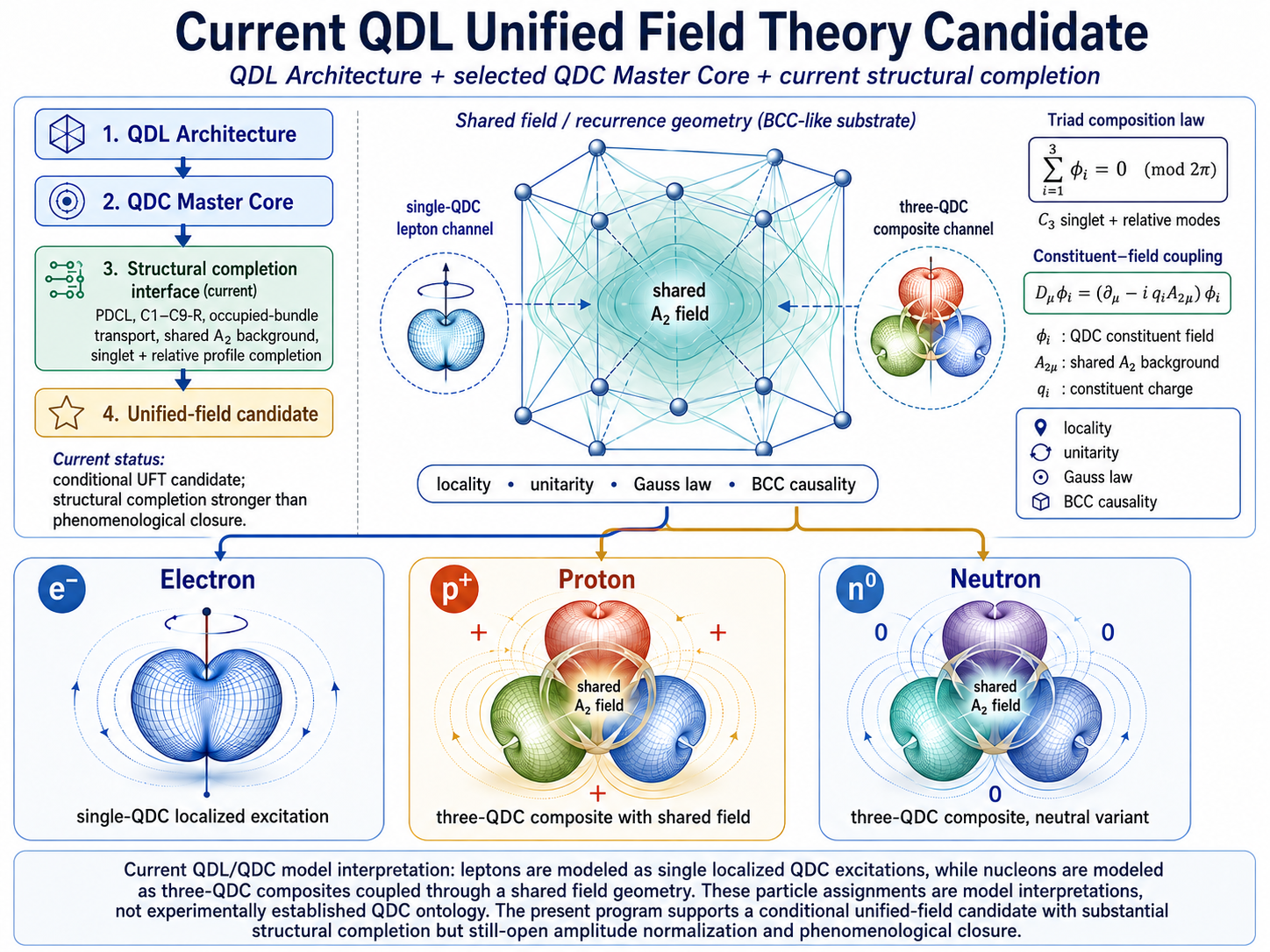
QDL UFT Candidate Infographic
Current graphical overview of QDL Architecture, the selected QDC master core, structural completion, and particle-capacity interpretation.
Current QDL Unified Field Theory Candidate
This graphical abstract is the current visual summary of the working QDL/QDC unified-field architecture. It distinguishes QDL Architecture, the selected QDC master core, current structural completion, shared-field recurrence geometry, and the model-level single-QDC and three-QDC particle channels.
Major Current Research Records
The principal public anchors for the present QDL/QDC program.
The frozen August 10, 2026 public research record through QDL-QM5R3G. It consolidates program architecture, current constitutive completion, gravity and particle-capacity results, predictive status, quantum-measure work, claim-strength ledgers, computational gates, and the open physical-closure boundary.
This record presents QDL/QDC as a conditional unified-field candidate, not as a completed or experimentally confirmed unified field theory.
The principal long-form synthesis of the present QDL research architecture. It gathers primitive closure, physical admissibility, QDL/QDC structure, recurrence, completion physics, particle-capacity models, gravity, claim boundaries, and open research gates.
This is the most comprehensive single-volume reference for understanding the intellectual architecture underlying the current Completion-Gate Series.
Public theorem and evidence archive supporting the transition from structural architecture toward explicit finite-model dynamics and completion testing.
Finite closure ledgers, recurrence structures, ordered-pair phase domains, QDC balance, baryon charge residues, and related machine-readable computational controls.
Peer-Reviewed Foundation
The first peer-reviewed QDL anchor.
Published in the Journal of Theoretical and Applied Physics. This paper provides the peer-reviewed foundation for the dimensional-closure and QMU-ledger layer of the broader program.
Recommended Resource Path
A current route through the public evidence base.
QDL in 5 Minutes
Begin with the accessible overview of closure, QDL/QDC architecture, and the present claim boundary.
Primitive Closure and the Architecture of Physical Admissibility
Use the major synthesis for the broadest integrated treatment of QDL architecture and completion physics.
Toward a QDL Unified Field Theory
Read the frozen V1.0 consolidated status, evidence, gate, reproducibility, and open-problem record.
Live Completion-Gate Status
Use the Research Program page for developments after the frozen V1.0 cutoff and the current active proof frontier.
Publications & Archives
Move into the complete DOI-backed research record when examining individual theorem, model, computational, and application branches.
Selected QDL/QDC Graphics
Current and historically useful visual summaries.
Current QDL Unified Field Theory Candidate
Current August 2026 visual summary of QDL Architecture, selected QDC master core, structural completion, shared field, and model-level particle capacity.
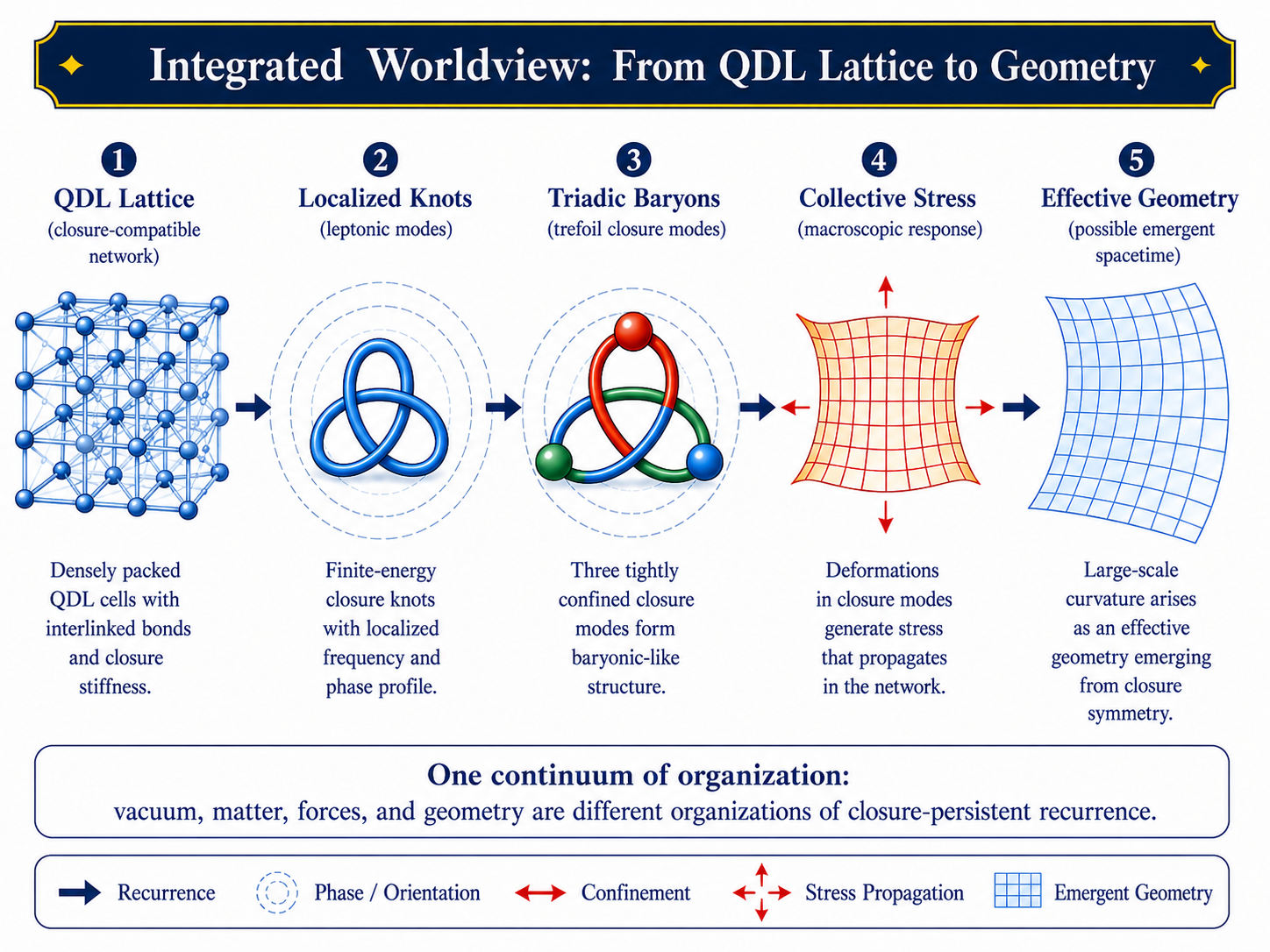
Integrated QDL Worldview
Earlier conceptual overview connecting the recurrence substrate picture, localized modes, composites, collective response, and effective geometry.
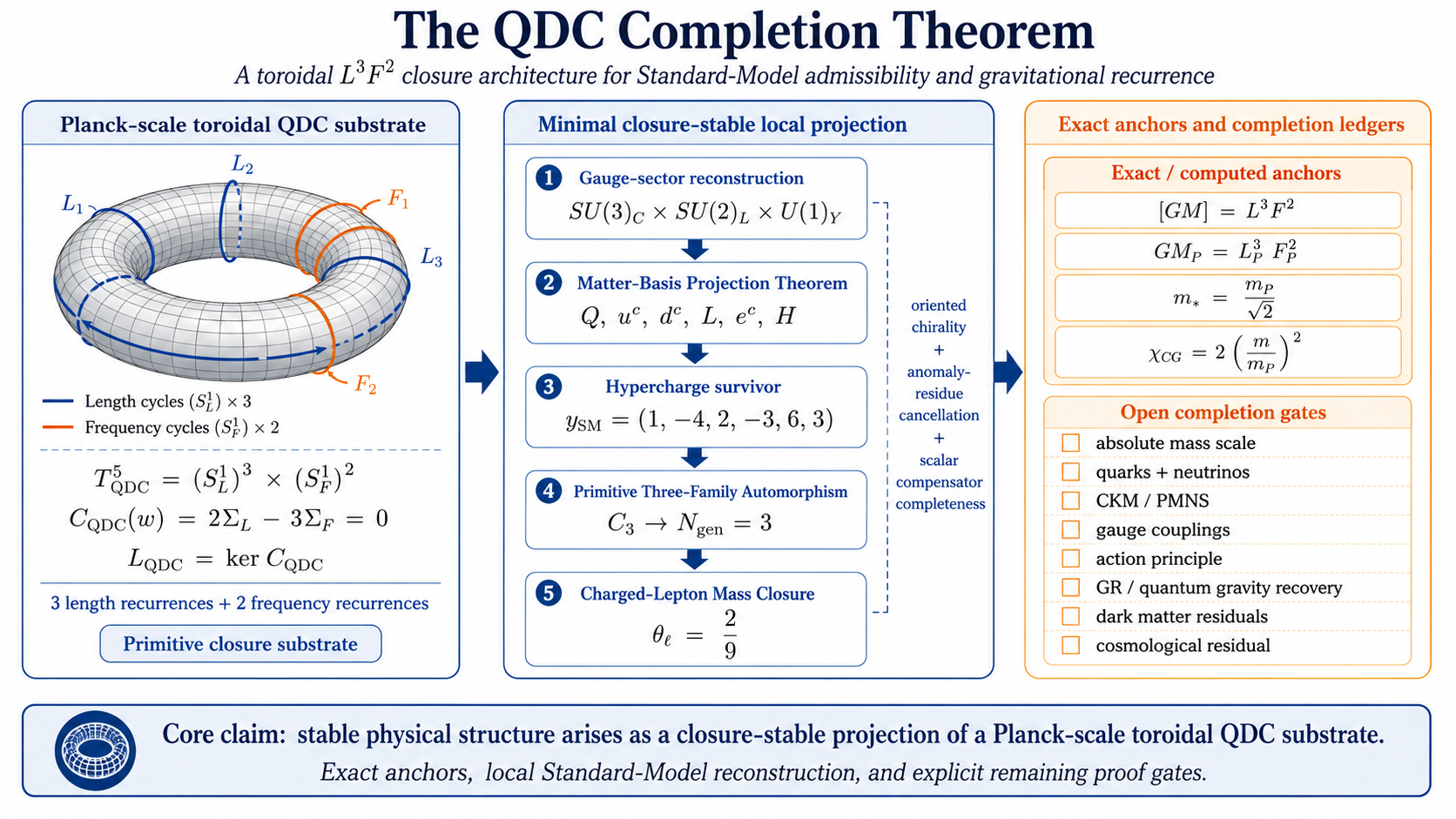
QDC Completion Theorem
Graphical summary of an earlier completion-theorem spine, exact anchors, conditional reconstruction steps, and open proof gates.
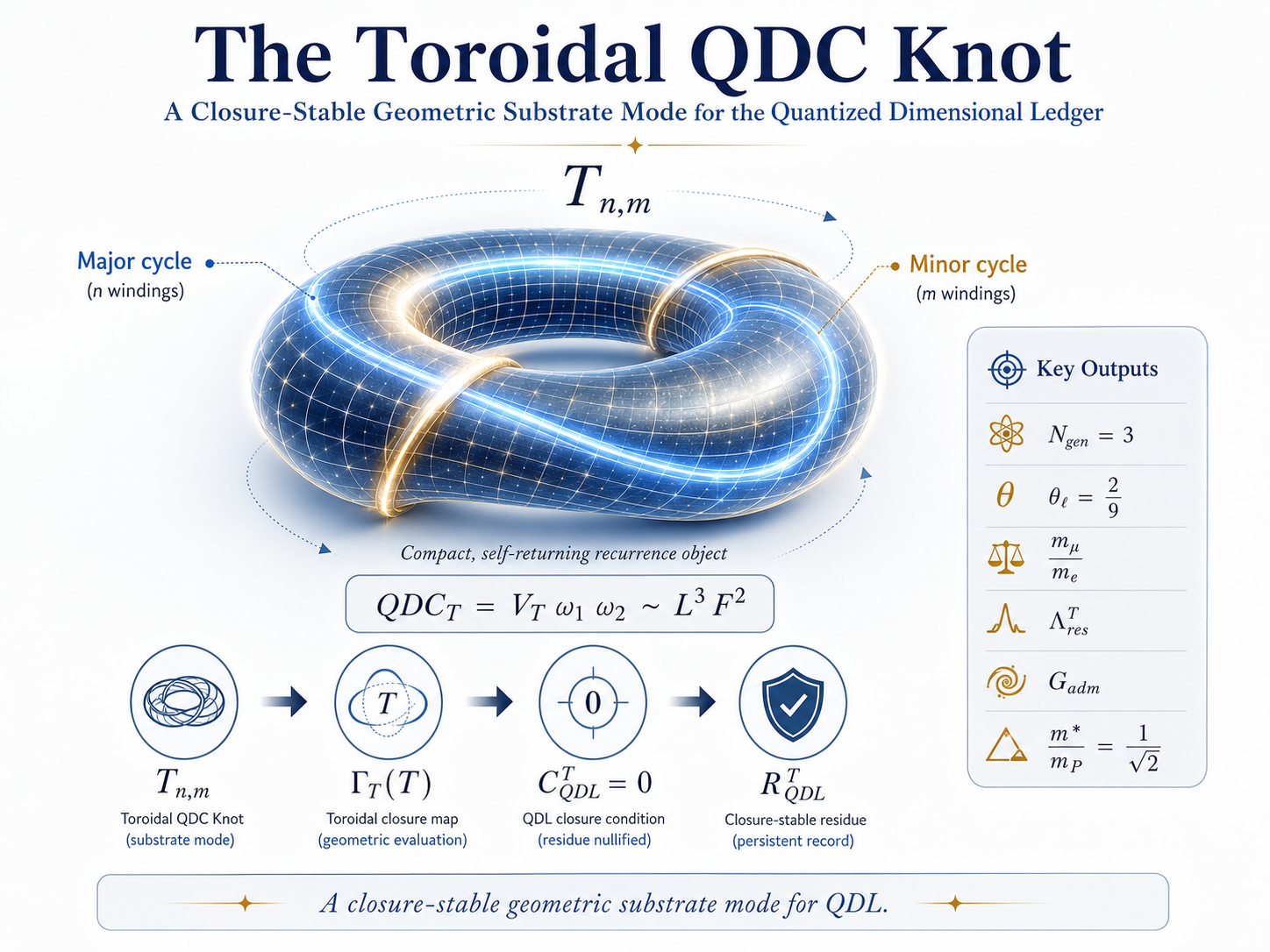
Toroidal QDC Knot
Geometric visualization of the compact two-cycle toroidal recurrence construction used in an earlier QDL/QDC substrate branch.
Historical graphics should be read in the claim-status context of the research record current when they were produced. The August 2026 UFT candidate infographic is the preferred current high-level visual.
Reproducibility & Audit Resources
Machine-readable and audit-oriented records.
Finite closure ledgers, recurrence structures, charge-residue controls, and machine-readable supporting records.
Consolidated theorem, audit, reproducibility, and falsification record for the physical-completion program.
Representative machine-readable source-anchored audit subset for QDL closure-vector classification of Warsaw-basis SMEFT operator mixing.
Reproducibility archives document what was actually executed under frozen assumptions. They should not be interpreted as experimental confirmation merely because a numerical or algebraic control passes.
Selected Earlier Technical Records
Useful historical and branch-specific resources.
Earlier roadmap and program-architecture synthesis covering claim-status firewalls, closure layers, and validation paths.
Earlier substrate-capstone formulation of QDL as a closure-admissibility theory of physical persistence.
Compact two-cycle recurrence candidate and geometric substrate-mode construction.
Earlier theorem-level completion map connecting QDC architecture, Standard-Model admissibility, family structure, and explicit open proof gates.
Numerical mass-spectrum application involving occupancy-amplitude closure, Koide geometry, and relational phase structure.
QDC realization in gravitational dynamics, including the dimensional structure of μ = GM and Keplerian closure.
Benchmark & Null-Test Archives
Earlier executable records preserved for methodological auditability.
Residual-first methodological benchmark program using declared model families and public-data audit logic.
Reproducible method-oriented benchmark record, preserved as an audit resource rather than as evidence of a new physical effect.
Executable optical-cavity benchmark intended for methodological testing and replication.
DOI-backed executable benchmark sequence exploring an SO(10)-compatible QDL grand-unification branch, including gauge running, scalar-threshold hardening, proton-decay exposure, flavor, and leptogenesis controls.
This remains a benchmark-level branch, not the present selected fundamental QDL/QDC UFT.
Benchmark resources are retained because failed, null, and method-oriented results are part of the program's reproducibility history.
Tools & Executable Infrastructure
Structural-admissibility concepts applied as practical validation tools.
Interactive examples of ledger-vector assignment, dimensional closure, and structural-admissibility testing.
The calculator is a demonstration and educational tool. It does not replace the formal definitions, papers, or research archives.
QDL Physics Institute has also developed an executable infrastructure direction for structural-admissibility validation of measurement and modeling pipelines.
The concept includes ledger-vector assignment, closure testing, audit traces, warnings or rejection, and possible repair recommendations for structurally inconsistent models or pipelines.
Status recorded by the Institute: U.S. Provisional Patent Application No. 64/055,985, Systems and Methods for Structural Admissibility Validation of Physical Measurement and Modeling Pipelines ; patent pending.
Books & Reader-Facing Material
Accessible entry points alongside the formal research record.

This volume provides a more accessible book-length orientation to the QDL program. Readers seeking the most current technical synthesis should now use Primitive Closure and the Architecture of Physical Admissibility and the consolidated UFT research record.
How to Use This Resource Library
Different materials serve different scientific purposes.
Use the Research Program page. It is the living status layer and should control how older technical resources are interpreted.
Use the DOI-backed papers, datasets, monographs, and archives listed on Publications .
Prefer frozen computational archives, source bundles, machine-readable ledgers, manifests, verifier outputs, and preregistered gate records.
Use QDL in 5 Minutes and the graphical abstracts.
Older QDL papers and graphics remain useful as development records but should not automatically be interpreted as the program's current strongest formulation.
Use the frozen research archives and preregistered controls rather than reconstructed descriptions from later summaries.
- Current research status: QDL/QDC Unified Field Theory Completion-Gate Series
- Consolidated frozen UFT archive: DOI 10.5281/zenodo.21894736
- Major synthesis: Primitive Closure and the Architecture of Physical Admissibility
- Peer-reviewed foundation: Journal of Theoretical and Applied Physics
- Zenodo community: QDL Physics Institute
- Complete bibliographic record: Publications