
QDL in 5 Minutes
The Quantized Dimensional Ledger, or QDL, begins with a simple idea: before a physical model is fitted to data, ask whether its dimensional and structural relationships are internally admissible.
The broader QDL/QDC research program asks a more ambitious question: can the same closure principles select nontrivial physical architecture and then be extended into explicit dynamics for fields, localized particles, composite particles, gravity, and ultimately a unified theory?
The present answer is: QDL/QDC is a conditional unified-field candidate undergoing active theorem, computation, reproducibility, and falsification testing. It is not presented as a completed or experimentally confirmed unified field theory.
From L³F² to Standard-Model representation structure
One of the strongest current results can be summarized as a six-stage structural spine. It begins with the L³F² dimensional anchor and, inside the declared QDL construction premises, proceeds through the QDC closure character, the 3+2 gauge architecture, hypercharge, the minimal chiral matter sector, and Higgs-doublet quantum numbers.
Claim boundary: L³F² is the dimensional anchor. The later arrows are results within declared QDL premises and construction rules; they are not consequences of dimensional analysis alone. H denotes the selected Higgs-doublet representation and quantum numbers. It does not yet determine the Higgs potential, electroweak vacuum expectation value, absolute masses, Yukawa matrices, or coupling values.
From QDL Architecture to a Conditional Unified-Field Candidate
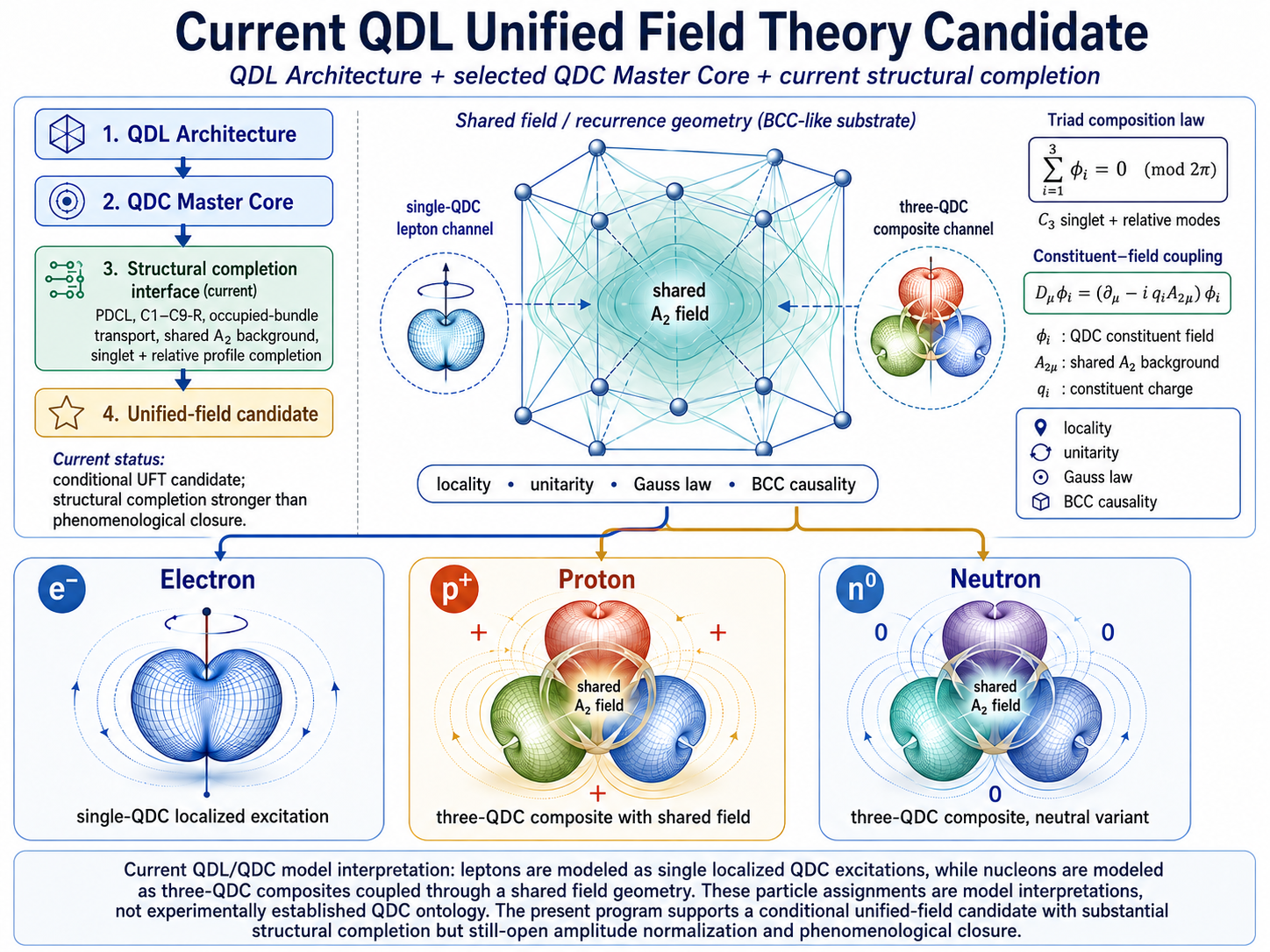
The current research program combines the structural QDL architecture—including the status-controlled route from L³F² into Standard-Model representation structure—with a selected QDC master core and an expanding set of structural completion laws. This is the present working route toward a QDL unified-field theory.
Prefer to Watch It?
The three animations move from the conservative audit layer to the broader physical interpretation.
QDL Structural Admissibility in 5 Minutes
See how a real construction becomes a five-slot ledger vector, how exact closure is tested, and why matching aggregate dimensions do not necessarily imply structural admissibility.
From GM to the QDC
Follow the L³F² signature from operational gravity into compact recurrence and the status-controlled structural chain through S(U(3)×U(2)), hypercharge, chiral matter, and H.
A QDL/QDC Worldview of the Planck Scale
Continue into the proposed physical picture of QDC recurrence, single-QDC lepton channels, three-QDC shared-field hadron channels, fields, gravity, vacuum filtering, and measurement records.
Recommended order: Structural Admissibility → From GM to the QDC → Planck Worldview.
The Five-Minute Path
Six ideas explain most of the current QDL/QDC program.
Start with primitive closure
QDL treats physical representation as more than symbolic bookkeeping. A model has a declared dimensional structure, and operations on that model should preserve the structure required for the physical interpretation being claimed.
In the basic QDL ledger, three length-like slots and two frequency-like slots form the primitive typed architecture.
Structural admissibility comes before fitting
Ordinary dimensional analysis asks whether units match. QDL asks a stricter question: does the construction remain admissible under the declared basis, target, transformations, compositions, residual conditions, and physical interpretation?
This upstream screen is the practical core already used in QDL metrology, measurement-chain analysis, operator audits, and model-validation work.
The structural program reaches Standard-Model architecture
The current QDL construction has a compact status-controlled route:
After the L³F² anchor, the arrows are results inside declared QDL premises. H means the selected Higgs-doublet representation and quantum numbers—not yet the Higgs potential, vacuum scale, absolute Higgs mass, Yukawa matrices, or coupling values.
The QDC master core turns architecture toward dynamics
The Quantized Dimensional Cell, or QDC, is the proposed physical recurrence carrier developed inside the broader QDL program. The selected master-core branch supplies explicit local and reversible recurrence/field structure rather than only a qualitative substrate picture.
Structural completion has advanced substantially. Unique cross-sector coefficient normalization and absolute physical amplitudes remain open.
The model now has particle and gravity capacity
The current model picture contains a localized single-QDC lepton channel and three-QDC composite channels coupled through a shared A2 field. In the present graphical interpretation, the electron occupies the single-QDC channel; proton and neutron are charged and neutral variants of the three-QDC shared-field channel.
Under declared completion assumptions, the gravity branch can enter the Einstein–Cartan / general-relativistic universality class with two local tensor modes. These are capacity and conditional results, not complete observed-particle or gravity phenomenology.
Every major claim must survive a gate
The research is organized as a Completion-Gate Series. Each gate freezes assumptions and success conditions before execution. A gate can pass, fail, or produce useful mathematics without satisfying its strongest physical objective.
The endpoint is not another internal match. It is a distinctive, no-fit physical prediction that survives independent replication and experiment.
The whole program in one line
What Is Currently Strongest?
A public-language summary of the current research layers.
What Is Still Open?
The main barriers between the current candidate and a completed physical theory.
Unique physical vacuum
The program still needs a non-arbitrary selection of the physical vacuum / Lorentz orbit.
Amplitude completion
A deeper principle must still determine the physically required cross-sector coefficients and absolute normalization.
Full particle phenomenology
The selected H representation does not yet determine the Higgs potential or electroweak vacuum scale. Complete masses, Yukawa/flavor structure, mixing, exchange statistics, hadronic structure, and observed-particle identification remain incomplete.
Global chiral measure
The determinant-line / quantum-measure Completion-Gate sequence remains active.
A distinctive nature-level result
The program still seeks a parameter-free observable that was not used to construct the theory and is subsequently confirmed by data.
External replication
A frozen blind replication package exists, but genuinely unaffiliated replication has not yet been completed.
What About Electrons, Protons, and Neutrons?
The same current particle picture used in the UFT graphical abstract and website animations.
The present QDL/QDC model picture distinguishes a localized single-QDC channel from a three-QDC shared-field composite channel.
Single-QDC localized excitation
The electron is modeled as a localized single-QDC excitation with internal orientation, recurrence, and field structure.
Three-QDC charged composite
The proton is modeled as three QDC constituents coupled through a shared A2 field and a triadic composition condition, in the charged composite variant.
Three-QDC neutral composite
The neutron uses the same three-QDC shared-field architecture in the neutral variant.
Does QDL reproduce general relativity?
There is a positive but conditional result. Under a declared Lorentz-orbit order parameter, a nondegenerate coframe, a positive Einstein coefficient, auxiliary torsion, and suppressed higher-curvature terms, the collective QDL-compatible dynamics enter the Einstein–Cartan / general-relativistic universality class.
That produces the familiar two local tensor modes.
Why is the quantum-measure work important?
A chiral gauge theory needs more than a classical field construction. Its quantum measure must also be globally consistent.
The current QM5R3 Completion-Gate sequence has developed exact determinant-line identities, continuum connection formulas, finite source-space reductions, and complex analyticity certificates.
The full technical story belongs on the Research Program page.
What QDL Does Not Currently Claim
The claim-status firewall is part of the methodology.
- QDL is not presently claimed to be a completed final theory of nature.
- QDL does not presently derive every Standard Model mass, mixing angle, coupling, or parameter.
- Selecting the Higgs-doublet representation H does not yet derive the Higgs potential, electroweak vacuum expectation value, absolute Higgs mass, Yukawa matrices, or electroweak coupling values.
- QDL does not presently derive the numerical values of Newton's constant or the cosmological constant from closure alone.
- QDL does not claim that microscopic QDC cells have been directly observed.
- QDL does not treat an internal numerical match or successful computational gate as experimental confirmation.
- QDL does not convert a failed gate into a successful physical claim.
Why Might QDL Matter?
Even before a final unified theory is established.
Better structural checking
QDL can be used to ask whether a measurement or model remains structurally meaningful rather than merely dimensionally homogeneous.
Fewer arbitrary constructions
Closure and admissibility conditions can eliminate mathematically available structures before large amounts of fitting or interpretation are invested in them.
Explicit failure conditions
Preregistered gates, machine-readable ledgers, public archives, and frozen controls make the research program easier to audit.
Three Good Places to Go Next
Current public entry points.
Primitive Closure and the Architecture of Physical Admissibility
The major long-form synthesis of primitive closure, physical admissibility, QDL/QDC architecture, and the broader physical-completion program.
Toward a QDL Unified Field Theory
Frozen V1.0 status archive of the theorems, computational gates, reproducibility record, and open physical-closure problems.
The Quantized Dimensional Ledger for Metrology
Peer-reviewed QDL foundation for dimensional closure, QMU ledgers, and the ontology of physical constants.
Where Should I Go From Here?
The seven-page QDL Physics Institute structure.
Research Program
For the current technical status, Completion-Gate sequence, strongest positive results, and open physical-closure problems.
Publications
For the full peer-reviewed, Zenodo, monograph, dataset, and manuscript record.
Resources
For graphics, computational archives, reproducibility records, benchmarks, tools, and supporting materials.
Benefits
For possible applications of structural admissibility in measurement, modeling, scientific software, engineering, and AI-supported science.
Institute
For the Institute mission, research philosophy, founder information, identifiers, and contact details.
QDL is now both a structural-admissibility framework and an active physical-completion research program.
Its strongest current role is structural: identifying and testing closure, admissibility, representation, and finite-model constraints. Within declared QDL premises, that layer now includes the compact structural route from L³F² through the 3+2 gauge, hypercharge, chiral matter, and Higgs-doublet representations.
Its more ambitious QDL/QDC branch asks whether that structural architecture, together with the selected recurrence core and completion physics, can uniquely determine amplitudes, vacuum, particle phenomenology, gravity, and predictions—and then survive independent experimental scrutiny.
That second task is still underway.