
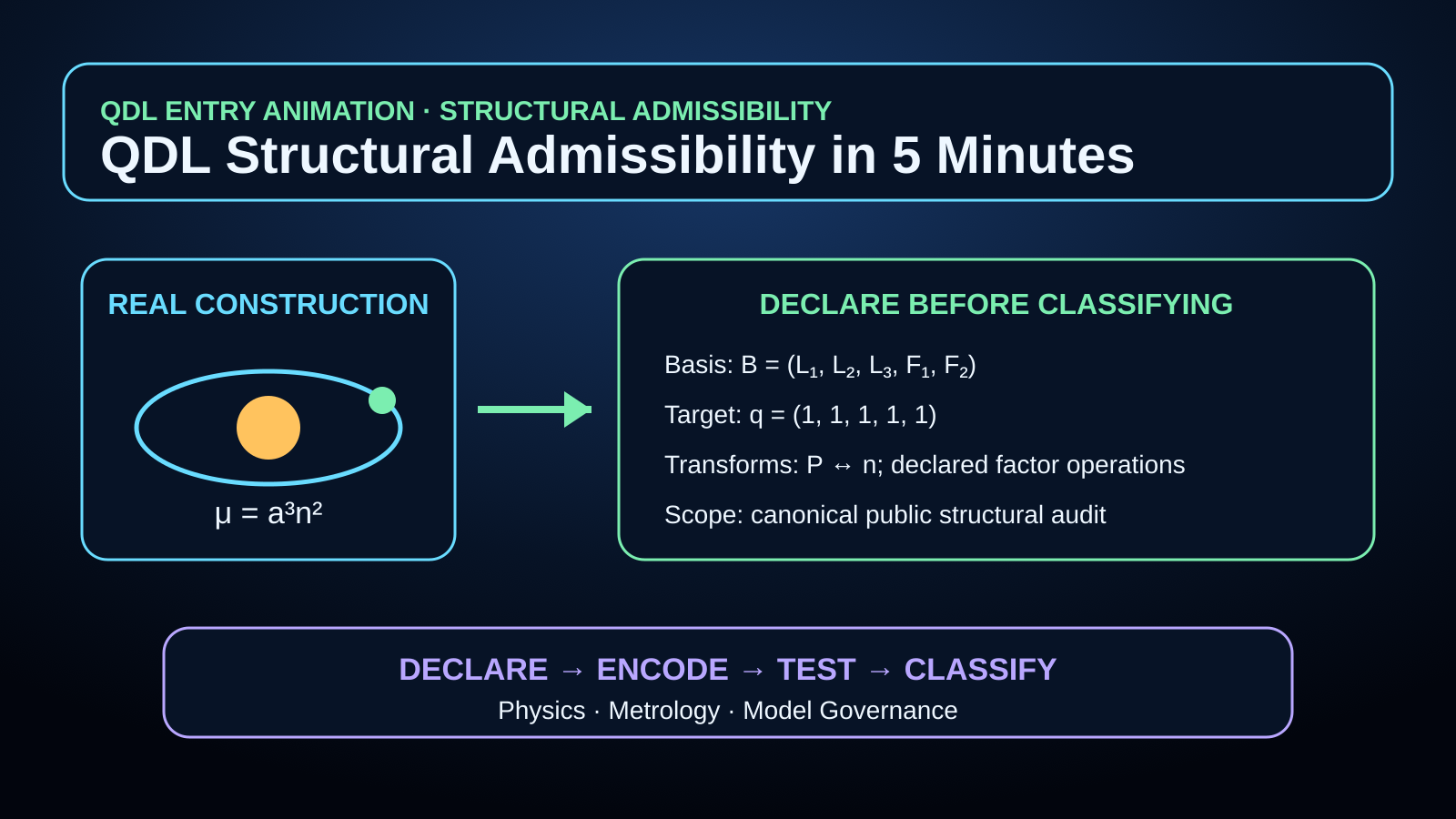
QDL Structural Admissibility in 5 Minutes
Begin with the method: declare the basis, target, allowed transforms, and scope; convert a real construction into a ledger vector; then compare admissible and non-admissible examples.
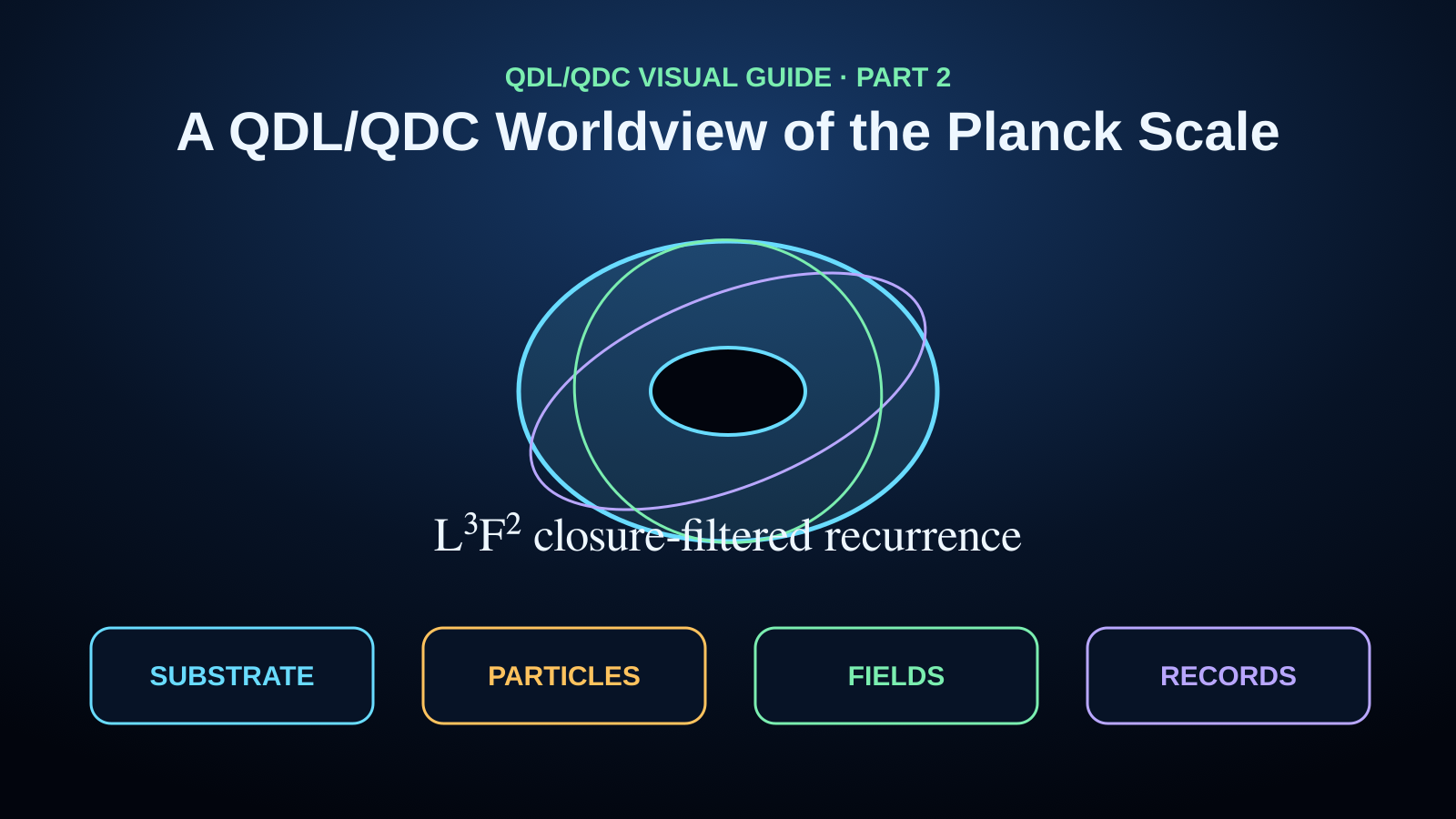
A guided sequence from the basic structural-admissibility framework to the QDL/QDC physical worldview and the physics-facing evidence chain.
Watch the animations in order. The first establishes the method, the second shows the conceptual picture, and the third makes the evidentiary and claim-status structure explicit.
Method first, interpretation second, evidence third.
Begin with the method: declare the basis, target, allowed transforms, and scope; convert a real construction into a ledger vector; then compare admissible and non-admissible examples.
Move from the structural screen to the intuitive physical picture: QDC cells, localized modes, composite structures, fields, interactions, and effective geometry.
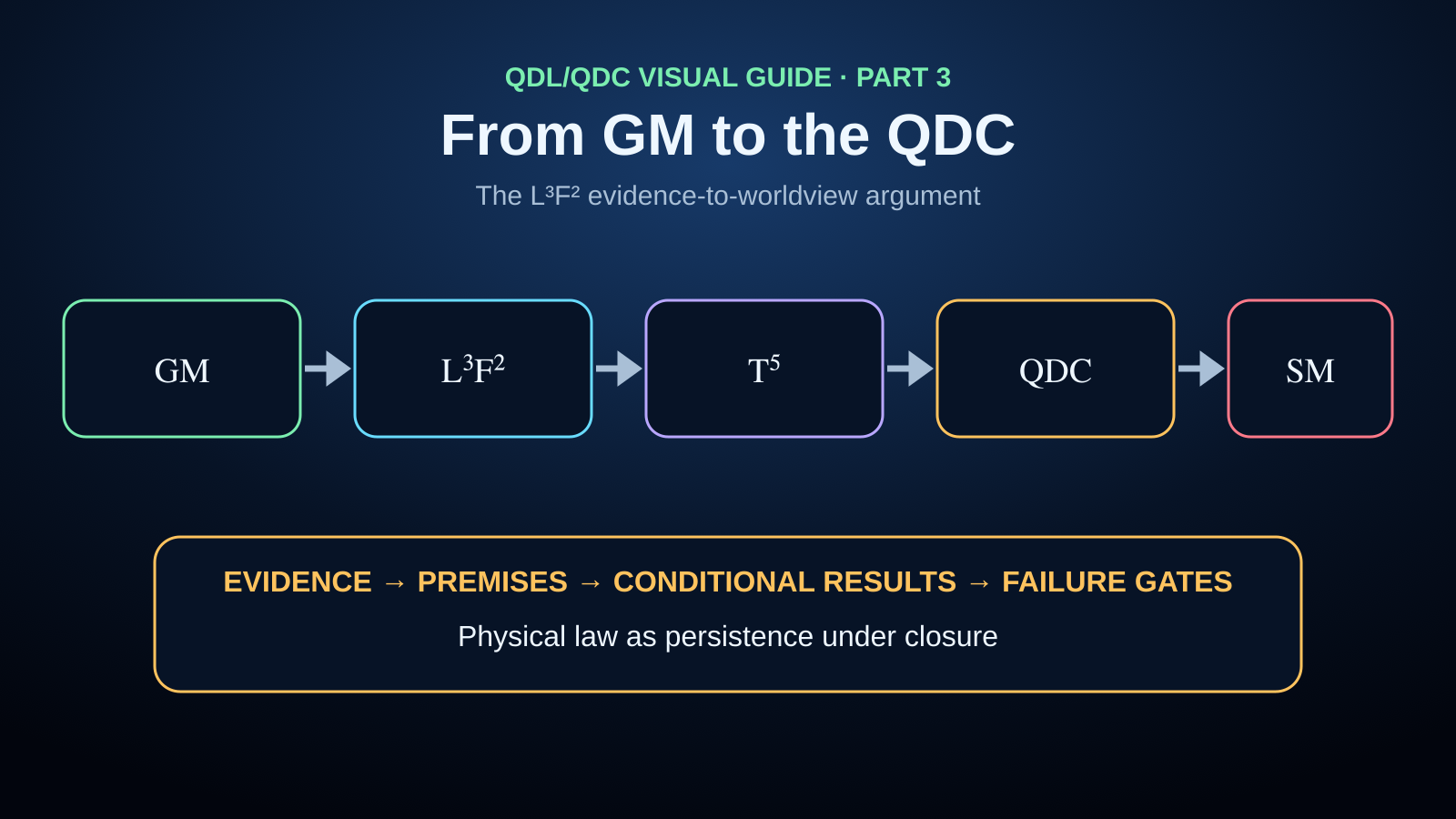
Follow the physics-facing evidentiary chain from measured gravitational structure through L³F², compact recurrence, the toroidal QDC, conditional Standard-Model structure, and open failure gates.
The sequence prevents the substrate picture from appearing before the admissibility method that motivates it.
Declare the basis, target, allowed transforms, and scope before classifying a construction. See a real orbital example converted into a ledger vector.
Only after the method is clear, move to the intuitive QDL/QDC picture of substrate, particles, fields, interactions, and records.
Finish with measured gravitational anchors, L³F² recurrence, conditional reconstruction, explicit claim status, no-go results, and open gates.
The animations are orientation layers. The formal definitions, calculator, experiments, benchmark records, and publications remain the authoritative technical record.