
Quantized Dimensional Ledger: From Primitive Closure Toward Physical Completion
The QDL Physics Institute develops the Quantized Dimensional Ledger (QDL) and Quantized Dimensional Cell (QDC) research program: a closure-first approach to dimensional structure, physical admissibility, recurrence, particle capacity, collective geometry, and unified-field completion.
The current QDL/QDC program is best described as a conditional unified-field candidate under active theorem, computation, reproducibility, and falsification testing . It is not presented as a completed or experimentally confirmed unified field theory.
The Unified Field Theory Completion-Gate Series tests which parts of the candidate follow structurally, which require additional completion physics, which can be evaluated computationally, and which remain open. Recent work has advanced both the structural Standard-Model route and the quantum-measure/determinant-line program while preserving explicit fail-closed claim boundaries.
For the current technical status, open completion problems, and gate sequence, see the Research Program. For citable frozen records and supporting archives, see Publications and Resources.
The current architecture in one line
The strongest compact map of the present QDL architecture begins with the operational dimensional signature L³F² and follows the declared QDL construction through the closure character, gauge group, hypercharge generator, minimal chiral matter sector, and Higgs-doublet representation.
QDL Visual Pathway
Three browser animations move from the audit rule, through the evidence-and-architecture chain, to the broader Planck-scale QDL/QDC model picture.
QDL Structural Admissibility in 5 Minutes
Begin with the upstream QDL question: whether a construction is structurally admissible before it is fitted, optimized, certified, published, or deployed. The animation introduces five-slot ledger vectors, the declared QDC closure direction, and worked admissible and non-admissible examples.
From GM to the QDC
Follow the L³F² signature from measured gravitational structure through compact recurrence and the QDL structural spine: L³F² ⇒ CQDC ⇒ S(U(3)×U(2)) ⇒ Y ⇒ Λ²V ⊕ V* ⇒ H. Claim-status labels distinguish established identities, exact results within premises, conditional results, model interpretations, and open gates.
A QDL/QDC Worldview of the Planck Scale
Continue from the controlled structural architecture to the broader QDL/QDC substrate interpretation: toroidal closure cells, particle modes, fields, gravity, electromagnetism, vacuum filtering, constants, interactions, and measurement records. This animation is explicitly presented as a model visualization, not as experimentally established microscopic ontology.
Recommended viewing order: Structural Admissibility → From GM to the QDC → Planck Worldview. The sequence is intentionally ordered from the most conservative audit layer to the broader physical interpretation.
Start Here
Four document paths into the QDL/QDC research program, complementing the visual pathway above.
QDL in 5 Minutes
A concise, equation-light introduction to dimensional closure, structural admissibility, QDL, and the QDC physical picture.
Research Program
The authoritative living status of the QDL/QDC Completion-Gate Series, major positive results, open physical-closure problems, and current frontier.
Publications
Peer-reviewed work, monographs, Zenodo datasets, research archives, manuscripts, and permanent DOI records.
Resources
Major synthesis works, computational archives, graphics, reproducibility records, and supporting QDL/QDC materials.
Current QDL/QDC Status
Public claim-status summary · August 2026
| Unified-field status | QDL/QDC is currently presented as a conditional unified-field candidate . It is not claimed to be a completed or experimentally confirmed unified field theory. |
| Architecture | The typed L³ × F² closure framework, representation/admissibility architecture, and QDC recurrence/master-core program provide the strongest structural layer of the current candidate. Within the declared QDL construction premises, the present structural spine is L³F² ⇒ CQDC ⇒ S(U(3)×U(2)) ⇒ Y ⇒ Λ²V ⊕ V* ⇒ H , with H denoting the selected Higgs-doublet representation and quantum numbers rather than a completed Higgs dynamics. |
| Completion structure | The current working decomposition is Pcompletion = Pstructural + Pamplitude . Structural completion has advanced substantially; unique cross-sector amplitude normalization remains open. |
| Particle capacity | Explicit localized and composite constructions, projective internal dynamics, compact closure-flux defects, and gauge dressing establish significant model-level particle capacity. Complete observed-particle ontology and phenomenology remain open. |
| Gravity | Under declared completion assumptions, QDL-compatible collective geometry can enter the Einstein–Cartan/GR universality class with two tensor modes. The unique Lorentz vacuum and gravitational normalization remain unresolved. |
| Quantum-measure frontier | The Completion-Gate Series has progressed from an exact one-dimensional Fredholm/Kato identity through low-rank defect factorization, direct continuum connection methods, finite source-space reduction, and complex Riesz-strip certification. The current mathematical frontier is rigorous canonical-chart certification. |
| Predictive status | A blinded CORE8A model fingerprint and external-replication protocol have been prepared. A distinctive nature-level no-fit prediction confirmed by independent experiment remains an open goal. |
| Peer-reviewed anchor | The Quantized Dimensional Ledger for Metrology , Journal of Theoretical and Applied Physics (2026). |
Toward a QDL Unified Field Theory
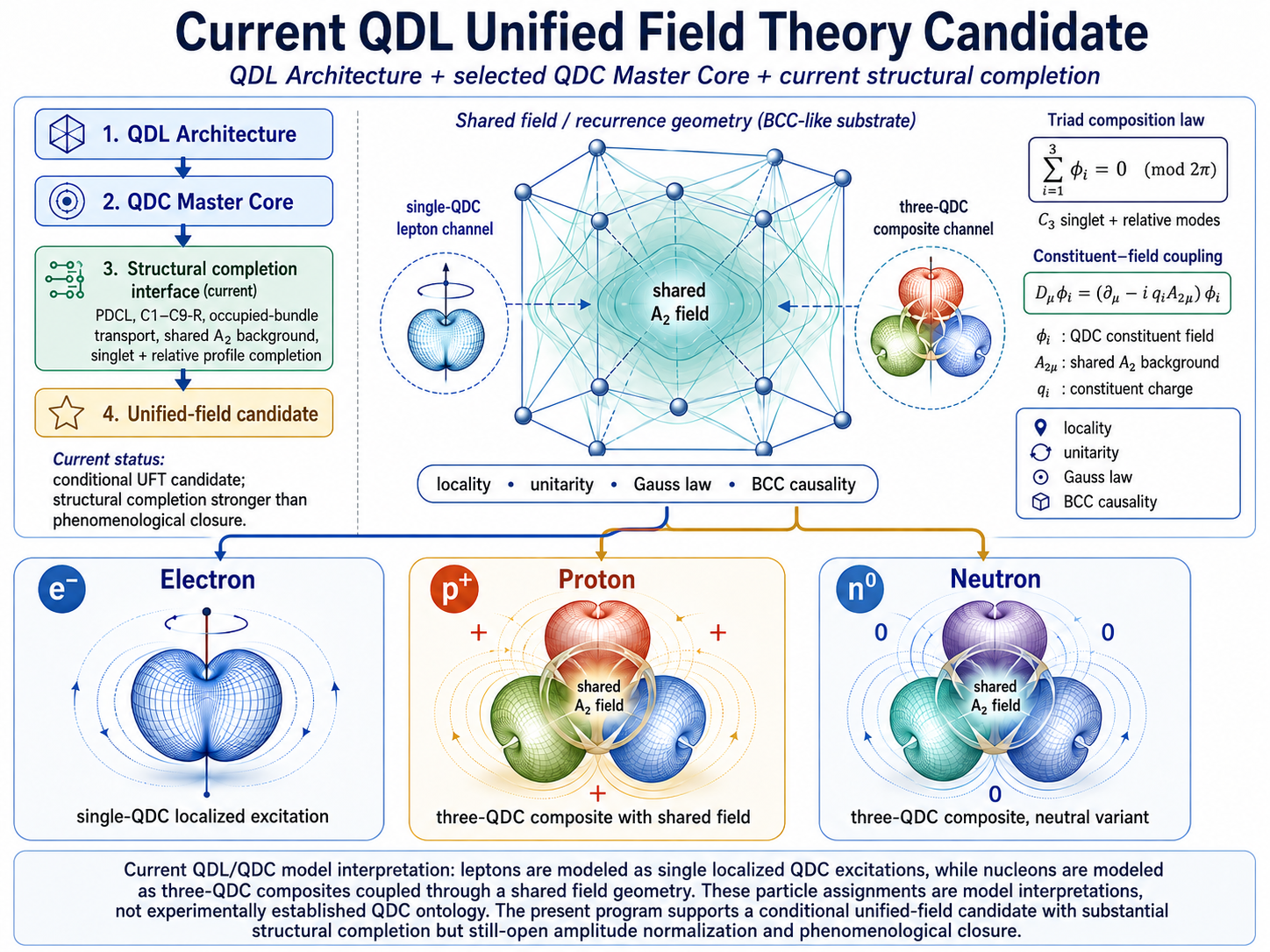
This frozen public archive consolidates the current QDL/QDC unified-field research architecture, constitutive completion stack, particle and gravity status, computational gate record, reproducibility infrastructure, quantum-measure frontier, and explicit open physical-closure problems.
The archive is deliberately claim-separated: exact theorems and computational finite-model results are distinguished from conditional selections, admitted completion laws, model interpretations, unresolved selectors, and empirical claims.
The record presents QDL/QDC as a conditional UFT candidate, not as a completed or experimentally established unified field theory.
What the archive records
QDL Architecture + selected QDC master core + Pcompletion
It records both the substantial structural progress and the remaining boundaries: amplitude normalization, vacuum selection, complete particle phenomenology, global chiral measure, distinctive prediction, and unaffiliated replication.
The V1.0 Zenodo archive is a frozen historical snapshot through QDL-QM5R3G. The live Completion-Gate Series has continued beyond that cutoff; current status is maintained on the Research Program page.
Primitive Closure and the Architecture of Physical Admissibility
Primitive Closure and the Architecture of Physical Admissibility is the major long-form synthesis of the QDL research program, bringing together primitive closure, structural admissibility, QDL/QDC architecture, recurrence, physical completion, particle-capacity models, gravity, and the broader route toward unified-field physics.
The work is intended as a comprehensive research synthesis and reference architecture. It gathers results, constructions, open gates, claim boundaries, and reproducibility material across the broader QDL program.
Claim-status note: the monograph presents a developing theoretical research program. It is not a claim that every component of observed physics has been uniquely derived or experimentally confirmed.
Bourassa, J. D. (2026). Primitive Closure and the Architecture of Physical Admissibility (Version 1.2.1). Zenodo. DOI: 10.5281/zenodo.21813133
A foundation for the current Completion-Gate Series
The monograph supplies the broader synthesis against which the present UFT Completion-Gate program can be read: what has been structurally established, what has been admitted as completion physics, what remains conditional, and what must still pass quantitative or experimental tests.
QDL Unified Field Theory Completion-Gate Series
A preregistered, fail-closed theorem and computational program.
Turning a structural candidate into a testable physical theory
The Completion-Gate Series asks, one gate at a time, which pieces of the QDL/QDC candidate can be proved, computed, uniquely selected, reproduced, or falsified. Gates are frozen before execution and do not receive post-hoc repair merely because a desired result fails.
Quantum holonomy
The QM5R3 sequence established an exact one-dimensional determinant-line/Fredholm formulation and progressively reduced the large-volume computation to finite source-space methods.
Canonical-chart certification
Work through QDL-QM5R3O has narrowed the current quantum-measure proof obligation to a rigorous canonical-chart certificate for the complex continuation needed to complete the continuum L=4 atlas. QDL-QM5R3P is the next preregistered repair gate.
Physical closure
Unique amplitude normalization, the physical vacuum, complete particle phenomenology, distinctive no-fit prediction, and unaffiliated replication remain central open problems.
Gate failure is part of the research record. A failed strong gate does not become a positive physical claim; it instead identifies the next mathematical or physical obstruction that must be resolved.
Major Public Research Records
Selected permanent anchors in the QDL/QDC public record.
Toward a QDL Unified Field Theory
Consolidated theorems, computational gates, reproducibility records, claim-strength ledgers, and open physical-closure problems.
Zenodo · Version V1.0 · DOI: 10.5281/zenodo.21894736
Primitive Closure and the Architecture of Physical Admissibility
Comprehensive synthesis of primitive closure, physical admissibility, QDL/QDC architecture, completion physics, and open research gates.
Zenodo · Version 1.2.1 · DOI: 10.5281/zenodo.21813133
The Quantized Dimensional Ledger for Metrology
Peer-reviewed foundation for dimensional closure, QMU ledgers, and the ontology of physical constants.
Journal of Theoretical and Applied Physics · 2026 · DOI: 10.57647/jtap.2026.2004.05
QDL Structural-to-Dynamical Completion Program
Theorem, audit, reproducibility, and falsification archive supporting the structural-to-dynamical completion program.
Zenodo · DOI: 10.5281/zenodo.21753200
QDL/QDC Computational Companion I
Public computational companion for finite closure ledgers, recurrence structures, QDC balance, and related reproducibility tests.
Zenodo · DOI: 10.5281/zenodo.20777498
Publications & Research Archives
Browse the complete peer-reviewed, submitted, monograph, dataset, and Zenodo research record.
For Readers, Editors, and Referees
Fast paths to the framework, evidence record, and current claim status.
Research Program
Current Completion-Gate status, strongest positive results, open problems, and explicit claim boundaries.
Publications
Peer-reviewed publications, Zenodo monographs, datasets, research archives, and manuscript status.
Resources
Reproducibility archives, graphics, computational records, major synthesis documents, and supporting materials.
Explore the Institute
The broader scientific purpose, potential applications, and institute mission.
Resources
Research archives, computational records, visual materials, DOI links, and reproducibility resources.
Benefits
Potential benefits of closure-first admissibility for metrology, modeling, scientific software, measurement systems, and consistency checking.
QDL Physics Institute
Mission, research philosophy, author information, open-science practice, and contact information.