Publications & Preprints

QDL Publications

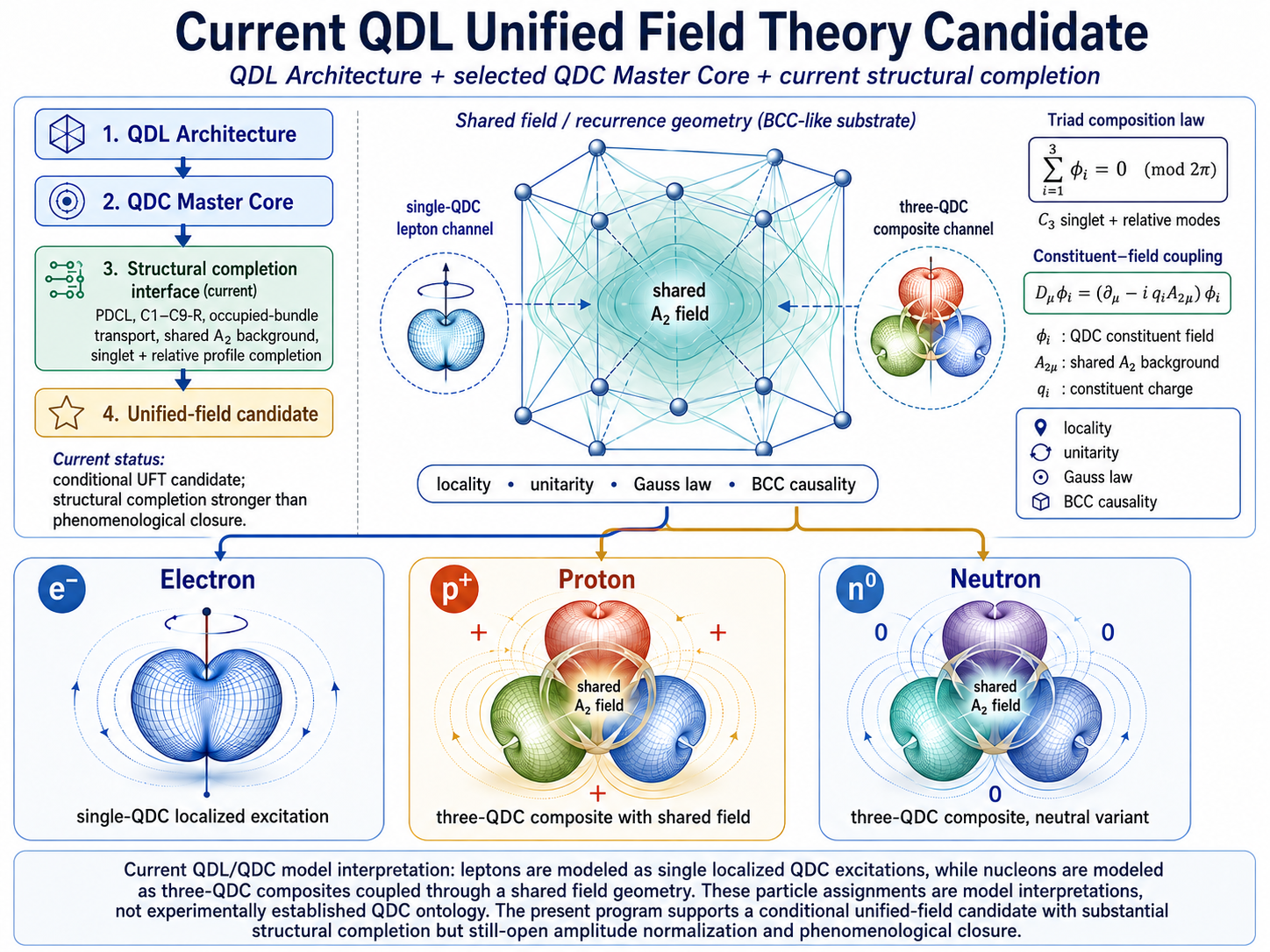
This page is organized around the current QDL hierarchy: the canonical QDL roadmap as the top-level program architecture; the JTAP metrology paper as the first peer-reviewed foundation; the Planck-scale substrate capstone as the substrate architecture; the Toroidal QDC Knot as the geometric substrate keystone; the QDC Completion Theorem as the completion-theorem spine; the SMEFT Γ(O) audit companion as the falsifiable operator-governance test; and the charged-lepton / mass-spectrum sequence as the numerical spectrum application.

```

For a live demonstration of structural admissibility under these rules, use the QDL Admissibility Calculator.

Canonical QDL roadmap JTAP peer-reviewed foundation QDL Substrate Capstone Toroidal QDC Knot QDC Completion Theorem SMEFT Γ(O) audit companion Mass-spectrum closure Core Closure Sequence Patent-pending infrastructure
Cover of The Quantized Dimensional Ledger
The Quantized Dimensional Ledger: A Structural Framework for Dimensional Coherence in Physics
Bourassa, J. D. (2026). Book. DOI: 10.5281/zenodo.18902770

This book is a reader-facing synthesis of the QDL program. The canonical mathematical structure and strongest technical claims remain in the DOI-backed papers and preprints.

```

Recent Program Milestones

Current QDL publication and application-layer updates.

```
May 2026 Canonical roadmap Program architecture Claim-status firewalls
Bourassa, J. D. (2026). Zenodo · DOI: 10.5281/zenodo.20461142

The canonical QDL orientation and program-architecture record. It synthesizes dimensional closure, QDC geometry, operator governance, mass-spectrum architecture, substrate persistence, measurement-chain integrity, claim-status firewalls, failure modes, and near-term validation paths.

This record frames QDL as a structural-admissibility program rather than a completed unification theory. It distinguishes definitions, reconstructions, ansatz-level hypotheses, audits, residuals, and theorem targets so that the program can be evaluated by explicit claim status and reproducible validation paths.

May 2026 Program capstone Substrate architecture Physical persistence
Bourassa, J. D. (2026). Zenodo · DOI: 10.5281/zenodo.20346814

The QDL substrate architecture record. This capstone defines QDL as a residual-first closure-admissibility theory of physical persistence and frames the substrate as the closure-persistent residue of candidate Planck-scale fluctuation structure.

Key contributions include a dimensionless Compton–gravity threshold, a charged-lepton mass-ratio reconstruction, a gravitational QDC-to-curvature bridge, a vacuum-filter toy model, a provisional SMEFT audit criterion, a full matrix-audit protocol, a measurement-chain closure theorem, and a constants-as-closure-operators interpretation.

May 2026 Geometric substrate keystone Toroidal QDC Planck-scale recurrence
Bourassa, J. D. (2026). Zenodo · DOI: 10.5281/zenodo.20367493
Toroidal QDC Knot graphical abstract showing two-cycle recurrence, toroidal QDC closure, and the QDL closure sequence
Graphical abstract for the toroidal geometric substrate keystone.

The canonical QDL geometric substrate-mode paper. It models Planck-scale candidate structure as a closure-stable toroidal two-cycle recurrence knot and gives the substrate capstone a compact geometric persistence object.

The central identity is QDCT = VTω1ω2 ∼ L3F2, with closure sequence Tn,m → QDCT → ΓT(T) → CTQDL = 0 → RTQDL.

Conditional links include a minimal three-family recurrence-class structure, the charged-lepton phase θ = 2/9, Koide occupancy-amplitude closure, vacuum residual selection, gauge-sector admissibility, non-SM exclusion, the Compton–gravity threshold, and a candidate toroidal QDC Hilbert space.

June 2026 Completion theorem Standard-Model admissibility Open proof gates
Bourassa, J. D. (2026). Zenodo · DOI: 10.5281/zenodo.20692677
QDC Completion Theorem graphical abstract showing the Planck-scale toroidal QDC substrate, minimal closure-stable Standard-Model projection, exact anchors, and open completion gates
Graphical abstract for the QDC Completion Theorem. The figure separates exact or computed anchors from conditional Standard-Model reconstruction steps and explicitly open completion gates.

The current QDL completion-theorem spine. This record consolidates the route from the Planck-scale toroidal QDC substrate to local Standard-Model admissibility and gravitational recurrence, using exact anchors, conditional reconstruction gates, and declared open proof targets.

The theorem-status claim is deliberately controlled: stable physical structure is proposed to arise as a closure-stable projection of a Planck-scale toroidal QDC substrate. The paper does not claim that every Standard Model constant has been computed. It identifies the finite gates that must close for QDL to become a candidate substrate-level completion theory.

Scope note: this paper should be read after the roadmap, JTAP metrology foundation, substrate capstone, and Toroidal QDC Knot, and before the SMEFT audit and charged-lepton numerical sequence.

May 2026 SMEFT Γ(O) Operator governance Machine-readable audit
Bourassa, J. D. (2026). Zenodo dataset · DOI: 10.5281/zenodo.20357001

The falsifiable operator-governance test for the QDL substrate program. This dataset provides representative source-anchored Warsaw-basis operator assignments, exact/source-anchored rows, strict-zero and compensator targets, verification taxonomy, data dictionary, changelog, sources table, README, workbook, and package ZIP.

Scope note: v1.0 is a representative source-anchored audit subset and scaffold. It does not claim completion of the full 2499 × 2499 three-generation SMEFT anomalous-dimension matrix, and it asserts no confirmed R-class violations.

May 2026 Mass-spectrum sequence Koide closure Numerical application
Bourassa, J. D. (2026). Zenodo · DOI: 10.5281/zenodo.20328260

The numerical spectrum application of QDL. This synthesis distinguishes derived occupancy-amplitude / Koide eigencone and relational-phase layers from phenomenological radial closure diagnostics.

The mass-spectrum sequence is now best read after the QDL roadmap, substrate capstone, and Toroidal QDC Knot because the roadmap provides the program architecture, while the toroidal paper gives a geometric interpretation of three-family recurrence and the charged-lepton relational phase θ = 2/9.

May 2026 Patent pending Executable infrastructure
QDL executable infrastructure enters patent-pending application phase
U.S. Provisional Patent Application No. 64/055,985

QDL Physics Institute has filed U.S. Provisional Patent Application No. 64/055,985, titled Systems and Methods for Structural Admissibility Validation of Physical Measurement and Modeling Pipelines.

This filing marks the executable infrastructure phase of QDL: applying structural admissibility as a machine-executable validation layer for physical measurement, modeling, simulation, uncertainty analysis, AI-generated scientific outputs, sensor fusion, digital twins, and related technical workflows.

Status: U.S. provisional patent application filed; patent pending.

```

Core Closure Sequence

The broader technical map supporting the seven-anchor hierarchy: roadmap, numerical ledger, spectrum selection, electroweak closure, flavor closure, operator governance, gravity, cosmology, closure grammar, and QDC realization.

```
Completion theorem QDC substrate Standard-Model admissibility Proof gates
Bourassa, J. D. (2026). Zenodo · DOI: 10.5281/zenodo.20692677

The completion-theorem spine of the current QDL program. It collects the exact anchors, conditional local Standard-Model reconstruction, primitive three-family automorphism, charged-lepton closure, gravitational recurrence, and remaining open proof gates into one theorem-status-controlled architecture.

Earlier roadmap Technical sequence Claim hierarchy
Bourassa, J. D. (2026). Zenodo · DOI: 10.5281/zenodo.20076081

The earlier roadmap and claim-hierarchy paper for the QDL technical sequence. It organizes the framework around structural closure, numerical closure, residual tests, spectrum selection, constants, operators, gravity, and cosmology.

```

Technical Pillars

The main hard-physics pillars supporting the current QDL closure program.

```
```

Closure Grammar, Residuals, and QDC Realizations

Sequence-level consolidation papers that sharpen compact closure grammar, residual tests, neutral matching structure, and physical QDC realizations.

```
```

Earlier Foundational Path

Earlier foundational papers and synthesis materials. These remain important, but the current primary entry path is now the seven-anchor hierarchy above.

```
```

QDL–SO10–1 Executable Grand-Unification Benchmark Series

A completed DOI-backed benchmark sequence applying QDL structural admissibility to an SO(10)-compatible grand-unification package.

```
Completed series Grand unification Executable closure
QDL–SO10–1 Series Overview
Nine-paper benchmark sequence · DOI-backed records

The QDL–SO10–1 series applies QDL structural admissibility to an SO(10)-compatible grand-unification benchmark. The sequence proceeds from benchmark definition through low-energy phenomenology, stress testing, executable gauge closure, scalar-threshold closure, operator-level proton-decay exposure, flavor/leptogenesis hardening, and integrated capstone synthesis.

The series is not presented as a final theory of nature. It is an executable, falsifiable benchmark program designed to make QDL-based grand-unification claims auditable and reproducible.

Paper #4 Historical perspective
The QDL Grand-Unification Benchmark in Historical Perspective
Historical perspective · superseded by Paper #9 capstone

Situates the initial QDL–SO10–1 trilogy against SU(5), Pati–Salam, SO(10), supersymmetric GUTs, E6, string/F-theory constructions, and modern nonminimal scans. This perspective is now superseded by the integrated Paper #9 capstone.

```

Executed Benchmark Records

Methodological records designed for auditability and replication. These do not claim new physical effects.

```
Executed benchmark Residual-first
Executed record · public-data method study

Residual-first adequacy testing under declared model families and parameter budgets.

Executed benchmark NV ODMR
Dataset / benchmark record · DOI-backed

Public-data benchmark record structured for replication and residual-first interpretation.

```

Selected Applications

Downstream uses and hypotheses best read after the QDL roadmap, JTAP foundation, substrate capstone, Toroidal QDC Knot, QDC Completion Theorem, SMEFT audit companion, mass-spectrum sequence, and Core Closure Sequence.

```

For the strongest technical entry, start with the recommended reading path above. After that, use the Core Closure Sequence for the technical map, the earlier foundational path for first principles, the benchmark records for auditability, the QDL–SO10–1 sequence for grand-unification benchmarking, and the application papers for scope expansion.

```