
QDL Admissibility Calculator
The QDL Calculator is an executable demonstration of the same closure logic used in the research program: candidate structures are tested not only for dimensional balance, but for admissibility under declared closure rules.
In the QDL Lattice interpretation, space is modeled not as absolute emptiness, but as a closure-compatible lattice of recurrence. Particles are persistent localized modes of that same structure, and geometry is investigated as a possible large-scale response of collective closure stress. This tool shows the structural-admissibility layer of that program in a public, editable form.
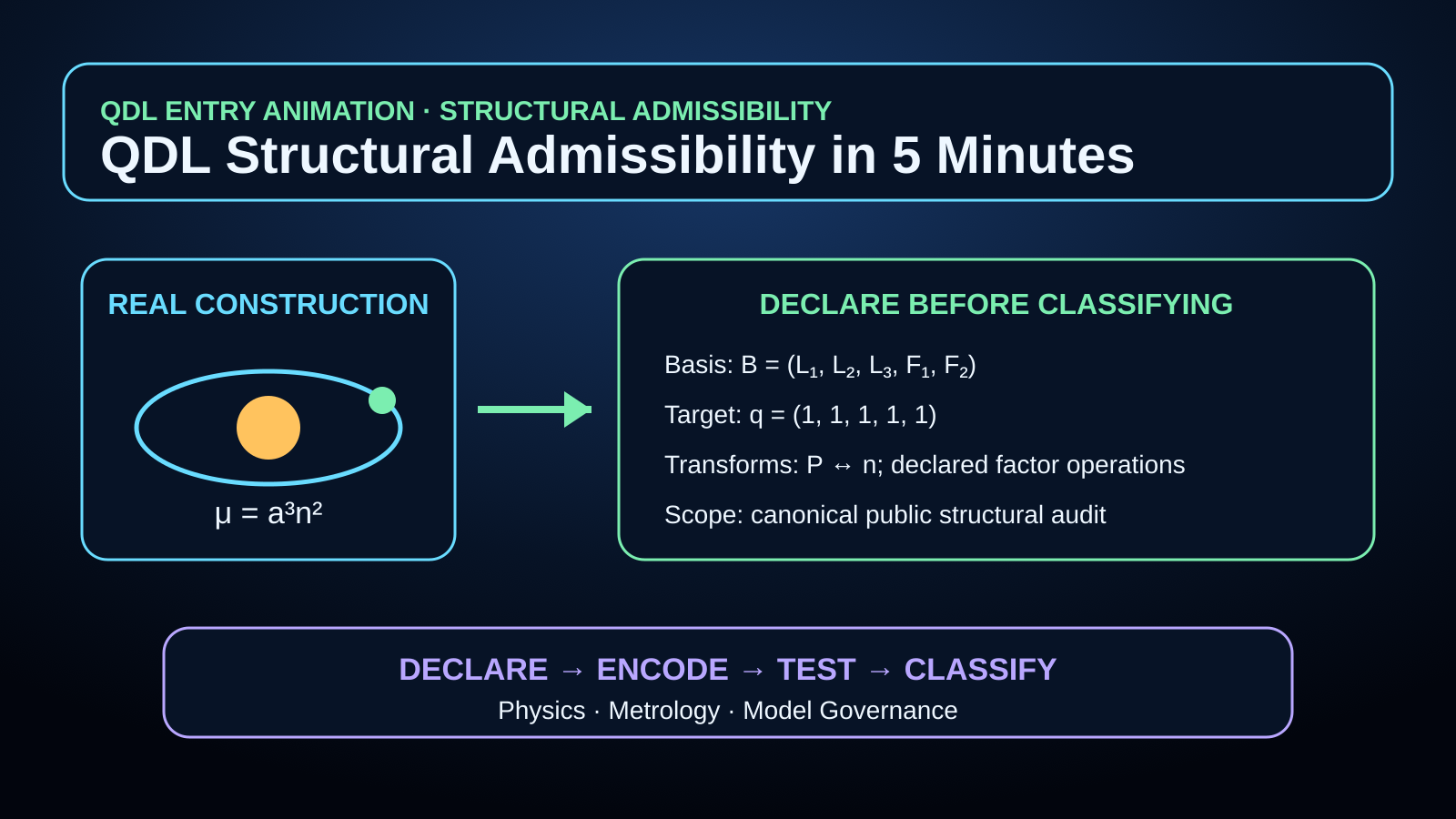
New to ledger vectors?
Watch the five-minute structural-admissibility primer before using the calculator. It begins with a measured orbital construction, declares the basis, target, allowed transforms, and scope, then converts the construction into a ledger vector and tests admissibility.
1) Canonical 3L + 2F ledger input
The basis is fixed here to the canonical QDL-style form: three length slots and two frequency slots. Enter the integer exponents for the expression or operator you want to test.
2) Closure rule and diagnostic charge
The default closure direction is the QDC direction. You can leave these defaults for public demonstration, or edit them when you want to test alternative subgroup or congruence rules.